Showing posts with label Peter Hammond. Show all posts

Monday, May 23, 2011

Happy 400th Birthday KJV

2011 is the four hundredth anniversary of the 1611 Authorized King James Bible. A publication that shaped history and cultures more than any other. It is a personal treasure of mine having been the first Bible I purchased after my conversion.

Following article courtesy of Dr Peter Hammond:

The 400th Anniversary of the King James Version of the Bible

The King James Version of the Bible/The Authorised Version stands like the Tower of London as a monument at the heart of the English speaking world. It is the best selling book of all time.

The KJV is the Bible that endured, having the greatest formative influence on the development of the English language worldwide. The KJV is actually one of the first British things to be made. It was made by the whole Island shortly after the inauguration of the United Kingdom of England and Scotland, when King James VI of Scotland became King James I of England.
Celebrations
For the 400th anniversary of the Authorised Version, Great Britain is hosting more than 70 different events, including a continuous reading of the whole Bible at Blackburn Cathedral, Symposiums at Cambridge and Aberdeen and St. Johns College in Cambridge are setting up a special exhibition. The British Royal Mail is issuing a special commemorative stamp. Even the British Broadcasting Corporation will show an hour long documentary. The Duke of Edinburgh launched the official celebrations in the banqueting house at Whitehall. Innumerable websites have been set up to celebrate the Authorised Version.

Foundational
There is no doubt that the KJV Bible is the most beloved and respected Bible in all of history. It has an ageless magnificence, a beauty of phrase and poetical arrangement which is absolutely unique. It is not possible to comprehend the history of the English speaking peoples without understanding the great KJV translation. The KJV Bible has most certainly been far more influential than even Shakespeare in the development and spread of English worldwide.

Superlatives
The KJV attracts superlatives. It is: the most important book in the English language, religion and culture, the most celebrated book throughout the English speaking world, the most enduring embodiment of Scripture in the English language and the gold standard by which all other Bible translations are evaluated. “All other versions still exist, as it were, in its shadow. It has shaped, formed and moulded the language in which the others must speak.” The KJV is the most pre-eminent Bible translation of all time. Without any doubt, this is the greatest example of English literature ever produced. No book ever had such a great impact on the development of a language and culture as the KJV has had. Nor can any other Bible translation claim to have inspired so many Revivals and the launching of so many missionary movements as the KJV.

Influential
The KJV is the most influential version of the most influential book in the world, in what has become the most influential language in the world.

Linguistic Rallying Point
English linguist, Professor David Crystal of Oxford University, following a strict methodology, came up with at least 256 idioms from the Authorised Version which have entered into the English language. This has included terms such as: feet of clay, land of milk and honey, whited sepulchres, girded loins, salt of the earth, and much more.

Bestseller
Most Gideon Bibles in hotel rooms are KJV. Oxford University Press alone sells over 250,000 copies of the KJV every year, which it describes as “the most widely owned and used translation.”

Before the KJV
Pre-Reformation Bibles were mostly in Latin. This precluded ordinary people from hearing or understanding the Scriptures. King Alfred the Great did translate the Gospels into Anglo Saxon. The Lindesfarne Gospels included Anglo-Saxon interlinear script written between the lines of the Latin text. Professor John Wycliffe of Oxford University translated the Latin Vulgate into English, publishing handwritten copies of the New Testament in 1380 and the Old Testament in 1382. However these were all only handwritten, few in number and inaccessible to the common man.

The Printing Press
The invention of the Printing Press by Johannes Guttenberg and the printing of the first book, a Bible in Latin, on a mechanical movable type printing press, made possible a revival of learning and education and a circulation of literature on a scale never before seen. This invention laid the groundwork for the Reformation in the 16th century. The Printing Press was often referred to as “The Reformers Friend, the Tyrants Foe!”

The Greek New Testament
In 1516 the imminent scholar Erasmus published the Greek New Testament (the Textus Receptus). This Greek New Testament made available by Erasmus was used by William Tyndale to translate the New Testament into English.

William Tyndale
The first English New Testament to be translated from the original languages, and printed, was William Tyndale’s work, which was first smuggled into England in 1526. In 1536, the Bible translator, William Tyndale was burned at the stake for this crime.

Myles Coverdale
William Tyndale’s co-worker, Myles Coverdale produced the official Great Bible of 1539 which was authorised by King Henry VIII “for reading aloud in churches”. The Great Bible was mostly the work of William Tyndale.

The Geneva Bible
In 1557 the Geneva New Testament in English was published to be followed in 1560 by the complete Geneva Bible. The accession to the throne of England of the young Edward VI, a Protestant, gave unprecedented religious freedom and impetus to the translation of the Bible into English. The untimely death of King Edward and accession to the throne of Bloody Mary led to a reign of terror (1553 to 1558), in which hundreds of men, women and children were burned to death, including some of the most prominent Protestant Bible translators, teachers, preachers and theologians, even the Archbishop of Canterbury, and author of the Book of Common Prayer, Thomas Cramer. This led many church leaders to flee to Switzerland for sanctuary. It is for that reason that the next Bible translation into English was the Geneva Bible, published in 1560.

The Geneva Bible was a good scholarly work using original Roman type, smaller fonts, and the familiar verse formats of today’s Bibles and highlighting particular words to show where they had been added to the original for emphasis. The Geneva Bible was in general use for over 60 years and was the Bible quoted by playwrights such as William Shakespeare. The Geneva Bible was the first to bring out a “pocket book” edition of the Bible that people could carry around with them more easily than the traditional large formats produced for public reading in church services.

The Bible of the Puritans
The Geneva Bible was one of the most historically significant translations of the Bible into the English language, preceding the KJV by 51 years. It was the primary Bible of the 16th century Protestant movement and the Bible used by William Shakespeare, Oliver Cromwell, John Milton, John Knox and John Bunyan in Pilgrims Progress. The Geneva Bible was the primary Bible of the Pilgrims who founded America and used by the Ironsides soldiers of Oliver Cromwell during the English Civil War.

The First Study Bible
The Geneva Bible was the first mechanically printed, mass produced Bible, made generally available, direct to the public, with a variety of Scriptural study guides and aids (including woodcut illustrations, maps, charts and indexes). Therefore the Geneva Bible was the world’s first Study Bible. Over 150 editions of the Geneva Bible were printed between 1560 and 1644. The very first Bible printed in Scotland was a Geneva Bible, in 1579. A Law was passed in Scotland that year requiring every household to purchase a copy. The study notes were Calvinist and Puritan in character and were particularly objected to by the bishops and royalty for being “seditious”.

The Bishops Bible
The official Bishops Bible was published in England in 1568. The Church of England issued the Bishops Bible, essentially a revision of the Great Bible, which was mostly based on William Tyndale’s work. The Bishops Bible remained in use in the churches until the King James Bible was published in 1611.

King James
When Queen Elizabeth I died on 24 March 1603, the crown of England passed to her cousin James I, who had already been King of Scotland for 37 years. During the royal procession of King James VI of Scotland to his coronation in London as King James I of the United Kingdom of Great Britain, a delegation of Puritans presented James the Millenary Petition, which had over 1,000 signatures representing 10% of the Clergy of England. This petition was the catalyst for the Hampton Court Conference.

The Puritans
The Puritans were loyal to the crown but they were Calvinists who insisted that England’s Reformation had not gone far enough.

The Presbyterians
The Presbyterians wanted to do away with the hierarchal structure of powerful bishops. They promoted instead a model of church administration under elders, or presbyters.

The Pilgrims
The Pilgrims were non-conformists, or separatists, who wanted the state out of church affairs altogether. Many of them would emigrate to North America.

Parliament
Parliament was eager to expand its power and the Puritans retained a significant influence and representation in Parliament.

The Papists
The Papists were the Roman Catholics who wanted the English church to be returned under the authority of the Pope. They were excluded from the translation process and attempted to assassinate King James and blow up Parliament in the foiled Gunpowder Plot on 5 November. This is remembered annually in the Guy Fawkes fire works.

The Privileged
The privileged bishops had exceptional power and wealth. They had seats in the House of Lords and were determined to resist the Puritans, Presbyterians and Pilgrims.

The Hampton Court Conference
James took the Puritan petition seriously enough to call for a conference which took place in October 1603 at Hampton Court. This luxurious, one thousand roomed, estate just outside of London had originally been built by Cardinal Wolsey. Only four moderate representatives of the Puritan cause were invited to participate in the conference before the king at Hampton Court. The nine Bishops and Deans and the Privy Council were clearly prejudiced against the Puritans. King James delivered the opening address making clear that the doctrine and policy of the state church was not up for evaluation, or reconsideration. He made no effort to hide his frustration with the Presbyterian model he had endured in Scotland. Those who had hoped that he would be sympathetic to the Presbyterian or Puritan cause had obviously misunderstood his intransigence on this issue. However, the Puritans were not allowed to attend the first day of the conference and when, on the second day, the four Puritans were allowed to join the meeting they started on the wrong foot by suggesting: “Let’s broaden the decision making base. Why shouldn’t the bishops govern jointly with a presbytery of their brethren, the pastors and ministers of the church.”

No Bishop – No King!
The king exploded in reply: “If you aim at a Scots presbytery it agreeath as well with monarchy as God and the devil!” The word presbytery was apparently like a red flag to a bull. King James uttered his final word on the matter: “No bishop, no king!”

Conform or Else!
The king warned the Puritans: “If this be all your party has to say, I will make them conform themselves, or else I will harry them out of the land, or else do worse!”

A New Translation
At this point Dr. John Reynolds, the President of Corpus Christi College of Oxford, a leader of the Puritan side in the Church of England, and one of the greatest scholars of his day, proposed a new translation of the Bible into English. King James responded warmly to this suggestion because he despised the then popular Geneva Bible. The king was troubled by the often revolutionary margin notes of the Geneva Bible which spoke extensively against corrupt and immoral kings. King James ordered that a single translation that the whole nation could rely on “to be read in the whole church”, should be produced by 50 of the nations finest language scholars and he approved rules for carefully checking the results, including no marginal notes at all to be effected, but only for the explanation of the Hebrew or Greek words, and to draw attention to parallel passages.

The Translation Teams
Six panels of translators had their work divided up between them; the Old Testament was entrusted to three panels, the New Testament to two and the Apocrypha to one. Two of the panels met at Oxford, two at Cambridge, and two at Westminster. The most learned men in the Universities of Oxford and Cambridge were to take the lead in the work which was to be reviewed by the bishops, presented to the Privy Council and lastly ratified by the Royal Authority.

The KJV must be the only work of literary genius to have been produced by a committee. The group of great scholars had unparalleled qualifications. Most of them had spent most of their lives in the pursuit of God and knowledge. One translator, Dr. Lancelot Andrews, mastered at least 15 languages and by the time he was 6 years old, had read the entire Bible in Hebrew. Some of the translators had written foreign language Dictionaries and Lexicons. They commonly debated in Greek, they translated and edited great works and they wrote their own. Not only did the translators know the Biblical languages of Hebrew, Aramaic and Greek, but many also knew related languages that enabled them to study other documents and translations by the church Fathers in Persian, Coptic, Syrian, Chaldea, Latin, French, Italian, German and Dutch. Some of the translators prayed five hours a day. The translators were world class scholars, Christians who lived holy lives and were prominent as deans, professors and presidents of major colleges of Oxford and Cambridge.

After the final draft was completed by the 54 scholars, a concluding committee of 12 reviewed what the lower committees had prepared, and then Bishop Thomas Bilson and Dr. Miles Smith added the finishing touches. By 1609 the whole revision was ready and Miles Smith, the Canon of Hereford, later to become the Bishop of Gloucester, and Thomas Bilson, Bishop of Winchester, saw it through to the printing press and Miles Smith composed the Preface “The Translators to the Readers.”

Although King James contributed no money to its production and although no record of an official authorisation of the finished product survives, if such were ever issued, the Bible came to be known as the King James Version. It was certainly not the only, or the first, Authorised Version. The Coverdale, or Great, Bible was the truly Authorised Bible (under Henry VIII) in English, and the Bishops Bible was Authorised by Queen Elizabeth I.

Initial Opposition
Not everyone supported the King James Bible at its first publication. Distinguished scholar Dr. Hugh Boughton declared that it “Bred in me a sadness that will grieve me while I breathe… tell His Majesty that I had rather be wrent in pieces with wild horses, than any such translation by my consent should be urged upon the churches… the new edition crosseth me. I require it to be burned.” John Lightfoot objected to the Apocrypha being placed in the Bible.

An Enduring Work
The KJV went through 15 printings in the first 3 years with the translation committees being forced to make some minor revisions. The KJV most people use today is the result of a final revision brought about in 1769. The KJV is an incredible achievement. An enduring work which has had an enormous effect on hundreds of millions of lives, on the English language, culture and world history. It is the most important translation of the most important book in what has become the most important language in the world.

A Treasure
In the Preface to the 1611 edition, the translators of the Authorised Version stated that it was not their purpose “to make a new translation… but to make good ones better.” They recorded their debt to the earlier works of William Tyndale and other Reformers and Bible translators. The New King James Version seeks to be faithful to the original text and to retain the King James Version style and idiom, while keeping abreast of changes in English speech.

A Challenge
In this 400th anniversary of the publication of the KJV why don’t you read through the whole Bible? If you read just 4 chapters a day, it will get you through the whole Bible in a calendar year. To know the God of the Word we need to study the Word of God. We have the whole KJV Bible available on audio MP3 which is ideal to play while commuting by car. CLB will be giving this KJV audio MP3 as a gift to all who order in-house titles this month.

“So then Faith comes by hearing and hearing by the Word of God.” Romans 10:17

Monday, April 18, 2011

18 April - Martin Luther's Date With Destiny

Facing Certain Death
Summoned to Worms, Luther believed that he was going to his death. He insisted that his co-worker, Philip Melanchthon, remain in Wittenberg. "My dear brother, if I do not come back, if my enemies put me to death, you will go on teaching and standing fast in the truth; if you live, my death will matter little." Luther at Worms was 37 years old. He had been excommunicated by the Pope. Luther would have remembered that the Martyr, John Hus, a Century before had travelled to Constance with an imperial safe conduct, which was not honoured. Luther declared: "Though Hus was burned, the truth as not burned, and Christ still lives... I shall go to Worms, though there be as many devils there as tiles on the roofs."

Luther's journey to Worms was like a victory parade. Crowds lined the roads cheering the man who had dared to stand up for Germany against the Pope.

Before the Emperor
At 4 o' clock on Wednesday 17 April, Luther stood before the rulers of the Holy Roman Empire. Charles V, Emperor of the Holy Roman Empire, ruled all the Austrian domains, Spain, Netherlands, a large part of Italy and the Americas. At 21 years old, Charles V ruled over a territory larger than any man since Charlemagne.

Amidst the pomp and splendor of this imperial gathering, stood the throne of the Emperor on a raised platform. It was flanked by Spanish knights in gleaming armour, 6 Princes, 24 Dukes, 30 Archbishops and Bishops, and 7 Ambassadors.


Luther was asked to identify whether the books on the table were his writings. Upon Luther' confirmation that they were, an official asked Luther: "Do you wish to retract them, or do you adhere to them and continue to assert them?" Luther had come expecting an opportunity to debate the issues, but it was made clear to him that no debate was to be tolerated. The Imperial Diet was ordering him to recant all his writings. Luther requested more time, so that he might answer the question without injury to the Word of God and without peril to his soul. The Emperor granted him 24 hours.

Confrontation
The next day, Thursday 18 April, as the sun was setting and torches were being lit, Luther was ushered into the august assembly. He was asked again whether he would recant what he had written. Luther responded that some of his books taught established Christian doctrine on faith and good works. He could not deny accepted Christian doctrines. Other of his books attacked the papacy and to retract these would be to encourage tyranny and cover up evil. In the third category of books, he had responded to individuals who were defending popery and in these Luther admitted he had written too harshly.

The examiner was not satisfied: "You must give a simple, clear and proper answer... will you recant or not?"

"Here I Stand"
Luther's response, first given in Latin and then repeated in German, shook the world: "Unless I am convinced by Scripture or by clear reasoning that I am in error - for popes and councils have often erred and contradicted themselves - I cannot recant, for I am subject to the Scriptures I have quoted; my conscience is captive to the Word of God. It is unsafe and dangerous to do anything against ones conscience. Here I stand. I cannot do otherwise. So help me God. Amen."

Amidst the shocked silence, cheers rang out for this courageous man who had stood up to the Emperor and the Pope. Luther turned and left the tribunal. Numerous German nobles formed a circle around Luther and escorted him safely back to his lodgings.

Condemned
The Emperor was furious. However, Prince Frederick insisted that Charles V honour the guarantee of safe conduct for Luther. Charles V raged against "this devil in the habit of a monk" and issued the edict of Worms, which declared Luther an outlaw, ordering his arrest and death as a "heretic."

Kidnapped
As Luther travelled back to Wittenberg, preaching at towns on the route, armed horsemen plunged out of the forest, snatched Luther from his wagon and dragged him off to Wartburg Castle. This kidnapping had been arranged by Prince Frederick amidst great secrecy in order to preserve Luther's life. Despite the Emperor's decree that anyone helping Luther was subject to the loss of life and property, Frederick risked his throne and life to protect his pastor and professor.

Wartburg Castle
For the 10 months that Luther was hidden at Wartburg Castle, as Knight George (Junker Jorg), he translated The New Testament into German and wrote such booklets as: "On Confession Whether the Pope Has the Authority to Require It; On the Abolition of Private Masses" and "Monastic Vows." By 1522, The New Testament in German was on sale for but a week's wages.

A Time of Change
The Reformation not only brought about sweeping changes in the church, but dramatic changes in all of society. First of all the Reformation focused on bringing doctrines, forms of church government, and of worship and daily life into conformity with the Word of God. But this of course had tremendous implications for political, economical, social and cultural life as well.

God's Word Above All Things
Luther revised the Latin liturgy and translated it into German. Now the laity received the Communion in both bread and wine, as the Husites had taught a Century earlier. The whole emphasis in church services changed from the sacramental celebration of the Mass as a sacrifice, to the preaching and teaching of God's Word. Luther maintained that every person has the right and duty to read and study the Bible in his own language. This became the foundation of the Reformation: a careful study of the Bible as the source of all truth and as the only legitimate authority, for all questions of faith and conduct.

The True Church
The Church is a community of believers, not a hierarchy of officials. The Church is an organism rather than an organisation, a living body of which each believer is a member.

Luther stressed the priesthood of all believers. We do not gain salvation through the church, but we become members of the Church when we become believers.

Reformation Basic Principles
Luther dealt with many primary issues, including:

1. Authority - the Bible alone is our authority and not the councils or leaders of the Church. The Bible is above tradition.

2. Salvation - is by the grace of God alone, accomplished by the atonement of Christ alone, received by faith alone. Grace comes before sacraments.

3. The Church - the true Church is composed of the elect, those regenerated by God's Holy Spirit. Regenerate Church membership.

4. The Priesthood - consists of all true believers. The priesthood of all believers.

The Battle Cries of the Reformation
The Protestant Reformation mobilised by Luther rallied around these great battle cries:
Sola Christus - Christ alone is the Head of the Church.
Sola Scriptura - Scripture alone is our authority.
Sola Gratia - Salvation is by the grace of God alone.
Sola Fide - Justification is received by faith alone.
Soli Deo Gloria - Everything is to be done for the glory of God alone.

Luther's Legacy
Despite Luther being declared an outlaw by the Emperor, he survived to minister and wrote for 25 more years, and then died of natural causes, 18 February 1546.

In spite of many illnesses, Luther remained very active and productive as an advisor to princes, theologians and pastors, publishing major commentaries, producing great quantities of books and pamphlets, and he completed the translation of The Old Testament into German by 1534. Luther continued preaching and teaching to the end of his life. He frequently entertained students and guests in his home, and he produced beautiful poems and hymns, including one hymn that will live forever: "Ein Feste Burg Ist Unser Gott" (A Mighty Fortress Is Our God).

Luther also did a great deal to promote education. He labored tirelessly for establishment of schools everywhere. Luther wrote his Shorter Catechism in order to train up children in the essential doctrines of the faith.

It has been common to portray Luther as a simple and obscure monk, who challenged the pope and emperor. Actually Luther was anything but simple or obscure. He was learned, experienced and accomplished far beyond most men of his age. He had lived in Magdeburg, Eisenach and was one of the most distinguished graduates of the University of Erfurt. Luther travelled to Cologne, to Leipzig, and had crossed the Alps, and travelled to Rome. Luther was a great student, with a tremendous breadth of reading, who had excelled in his studies, and achieved a Master of Arts and Doctorate in Theology in record time. He was an accomplished bestselling author, one of the greatest preachers of all time, a highly respected theological professor, and one of the first professors to lecture in the German language, instead of in Latin.

Far from being a simple monk, Luther was the Prior of his monastery and the district vicar over 11 other monasteries. Luther was a monk, a priest, a preacher, a professor, a writer, and a Reformer. He was one of most courageous and influential people in all of history. The Lutheran Faith was not only adopted in Northern Germany, but also throughout Denmark, Norway, Sweden, Finland and Iceland.

Luther was a controversial figure in his day and has continued to be considered controversial to this very day. There is no doubt that Luther's search for peace with God changed the whole course of human history. He challenged the power of Rome over the Christian Church, smashed the chains of superstition and tyranny and restored the Christian liberty to worship God in spirit and in truth.

"For I am not ashamed of the Gospel of Christ, for it is the power of God to Salvation for everyone who believes ...or in it the righteousness of God is revealed from faith to faith; as it is written, the just shall live by Faith." Romans 1:16-23

This Article is taken from: The Greatest Century of Reformation by Dr. Peter Hammond

Monday, February 28, 2011

The Real Story Of Martin Luther

We, in Denmark, had the great privilege of hosting Dr Peter Hammond who is (among many other things) the president of the Reformation Society. Dr Hammond made many fascinating presentations from history and the frontier mission fields last summer for our annual Reformation Resurrection conference but his touching presentation on the life of Martin Luther really stood out to me. Luther's bold stand against the evils of the Roman Catholic church, coupled with his dynamic recovery of our precious doctrine of justification by faith, often get lost in the shadow of historical revisionism which has painted an ugly picture of the reformer.

Without a doubt, Luther got things wrong, which he readily admitted himself. But we often forget the term "Semper Reformanda" - the Church reformed and always reforming. Later reformers went on to make more of the necessary reforms as the Protestant movement veered further and further away from the elaborate and idolatrous works righteous system that emanated from Rome. I think Paul Washer said it best when he declared that we stand on Luther's shoulders. If our theology is superior, it is only because of that monk who discovered the doctrine of justification by faith alone as he groped around in the immense darkness of that Catholic monastery and found a way out. Should we expect Luther to have had all his theological ducks lined up when he nailed his 95 Theses to the door of the church in Wittenburg?

It is interesting to note these words in the second chapter of the book of Judges:

When Joshua dismissed the people, the people of Israel went each to his inheritance to take possession of the land. And the people served the LORD all the days of Joshua, and all the days of the elders who outlived Joshua, who had seen all the great work that the LORD had done for Israel. And Joshua the son of Nun, the servant of the LORD, died at the age of 110 years. And they buried him within the boundaries of his inheritance in Timnath-heres, in the hill country of Ephraim, north of the mountain of Gaash. And all that generation also were gathered to their fathers. And there arose another generation after them who did not know the LORD or the work that he had done for Israel. (Judges 2:6-10 emphasis mine)

This is the turning point that sent Israel spiraling into some of the darkest chapters of their history - in fact the book of Judges finishes with several horrific stories and the closing words:

In those days there was no king in Israel. Everyone did what was right in his own eyes. (Judges 21:25)

Perhaps Frank Sinatra was actually paraphrasing the book of Judges in his song "I did it my way" which may also be the only song in the hymnal of hell.

Please note carefully the bold words I quoted above in Judges 2:6-10. Israel's tragic descent started with their failure to teach history and that history is His Story. Ray Comfort once said that "the only thing we learn from history is that we don't learn from history". May we not be like those before us and around us who run headlong towards the cliff. May we look back at our rich reformation heritage and the undeniable Sovereign hand of God in a movement that transformed every sphere of European society and won many into God's Kingdom. May we take the time to listen and learn as we take this journey back into the 16th century so we can press on in the 21st century with the knowledge that unless God builds the house, we all labor in vain . . .

Saturday, February 19, 2011

Just Added - Slavery, Terrorism, And Islam

Dr. Peter Hammond's shocking and sensational expose on the real history of Islam, and their many centuries of participation in slave trading, has just been added to my resource directory!

SLAVERY, TERRORISM, AND ISLAM
Peter Hammond

Category: Persecution
Click Here To Order
Slavery, Terrorism, and Islam - The Historical Roots and Contemporary Threat is a fascinating, well illustrated and thoroughly documented response to the relentless anti-Christian propaganda that has been generated by Muslim and Marxist groups as well as Hollywood film makers. As Karl Marx declared: “The first battlefield is the re-writing of History!” Dr. Hammond's book sets the record straight with chapters on “Muhammad, the Caliphas and Jihad”, “The Oppression of Women in Islam”, “The Sources of Islam” and “The Scourge of Slavery the Rest of the Story”. With over 200 pictures and 15 maps and charts, this book is richly illustrated. It consists of 16 chapters and 13 very helpful appendixes including demographic maps of the spread of Islam, a Glossary of Islamic Terms, a comparison of Muslim nations' military spending vs. their national prosperity, a chart on how Jihad works depending on the percentage of Muslims in the population and guidelines for Muslim evangelism.

Wednesday, February 2, 2011

Freedom Vote For Southern Sudan - Peter Hammond Gives The Latest From Sudan

It is always great to hear the reports Dr. Peter Hammond brings from the some of the more dangerous mission fields around the world. You won't hear much about Sudan on CNN or Fox but it is a place where Christians have suffered relentless Muslim persecution for centuries all the while being largely ignored by the UN. Please read this to be informed about the real news that is going on, and to gaisome valuable perspective on what life is like for most Christians who live outside of the western world. Take it away Peter:

A new country is about to be born as Southern Sudanese overwhelmingly voted for secession from the Arab North.

Final Walk to Freedom

From 9 to 15 January, South Sudanese voted in polling stations throughout the vast country and even across the world. Polling stations were set up as far afield as in the United States of America and Australia for the dispersed refugees and “lost boys of Sudan” to have their say in what is being called “the final walk to freedom.”

Violence in Abyei

The mostly peaceful elections were marred by a number of violent clashes, including a deadly ambush at 5pm Monday, 10 January. Misserlya Arab tribesmen killed 18 Southern Sudanese civilians and wounded 18 as they returned from the North to vote in the Referendum in the South.

Referendum in Abyei Postponed

In the disputed oil rich Abyei region, which is meant to have a separate Referendum on whether to join the South or the North, dozens of people were killed in violent clashes. The Referendum in this region was indefinitely postponed.

Counting the Votes

It is estimated that it will take the rest of the month to finalise collating and counting the votes from all the remote regions of Southern Sudan. However those votes which have already been counted are overwhelmingly for secession. At Juba University polling station it was 2,663 votes for secession to 69 for unity. At the tomb for veteran rebel leader, Dr. John Garang, who died in a helicopter “accident” under suspicious circumstances just weeks after being received by a crowd of over 3 million in Khartoum, 3,066 votes were counted for secession and just 25 for union with the North.

Observers Approve Referendum

The two largest foreign observer missions, the European Union and the Carter Centre Foundation have described the Referendum as “open and transparent” with over 95% voter turnout and therefore “valid.”

Logistical Challenges

Despite the tensions in the border regions, particularly in Abyei, huge crowds queued to cast their ballots. Southern Sudan is a vast and undeveloped region which has only about 40km of paved roads in an area the size of France and Belgium combined. The logistical challenges of conducting a Referendum throughout the war devastated regions of Southern Sudan were overwhelming. Many polling stations could only be reached by helicopter, or by motorbike. The first 30,000 ballots counted were 96% voting for secession and only 3% for unity. While that is only a small section of the 3.2 million votes cast, observers are convinced that almost everyone in Southern Sudan is for independence from the North.

War Wary

Since the British granted independence to Sudan, 1 January 1956, Sudan has been at war for most of the last 55 years. Just in the second phase of the war (1983 to 2005), an estimated 2 million people died and over 4 million lost their homes and were forced to flee.

A Fragile Peace

Oxfam estimated that just in the last year (2010) of peace, more than a thousand died in fighting between Arab Northerners and Black Southerners and more than 200,000 people had to flee their homes.

The Failure of the UN

Many non-governmental organisations have criticised the United Nations Peace Keeping Mission in Sudan (UNMIS) as having “so far failed to prioritize the protection of local people.”

Abyei Flash point

During the Referendum at least 50 Misserlya Arabs and 26 Southerners were killed in fighting in Abyei. Dissension between the Arab North and the Christian South on the Referendum in Abyei has led to the suspension of the separate Referendum there. The Northern government wants the Misserlya Arabs to have voting rights, while the South says that only permanent residents of Abyei, the Dinka Ngok, should vote. The Misserlya Arabs are nomads who only come to the South for grazing seasonally.

Separation or Unity

Because most Sudanese are illiterate the ballot papers are simply illustrated with a single hand marked Separation and another outline of clasped hands marked Unity.

Goodbye to Khartoum

One Southerner, Tom Drani said: “we are saying goodbye to Khartoum, the capital of old Sudan. We are coming to have our own capital here in Juba.” Atem Yak said: “I never saw the flag of Sudan as something I owed allegiance to. The national anthem never represented my will. So I will not shed tears when Sudan breaks into two. I will be happy.”

Ecstatic Rejoicing

Former UN Secretary, General Kofi Annan, said that he had never seen more smiles than at the polling stations at Southern Sudan. All have reported on the overwhelming enthusiasm and ecstatic joy witnessed in the long queues at polling stations in the South.

Many Died for Freedom

Col. William Ngang Ayuen said: “We lost a lot of people. Today is good for them.” Southern Sudan President Salva Kiir voted at the tomb of rebel hero John Garang. President Salva Kiir declared: “I am sure they did not die in vain.”

A New Nation

Signs in the crowd declared: “A new nation to be born on the African continent!!!” Sudan, geographically the largest country in Africa, will lose a third of its land, nearly a quarter of its population and most of its oil, if the South secceeds.

Delivered from Oppression

Julia Kiden said: “We feel that after the Referendum we will be delivered from oppression from the North.”

U.S. Incentives

The United States has offered the government of Sudan many incentives to allow a peaceful Southern vote, including removal from its list of State Sponsors of Terrorism and the lifting of economic sanctions.

Lost Boys of Sudan in America

Polling stations were set up in 8 American cities to accommodate the many refugees from Southern Sudan living in the USA. Baseball star, Luol Deng, arrived at a polling station in the North Side of Chicago, saying: “A lot of people have fought for this day, a lot of lives have been lost over this and now we have a say. All we could do in the past is run. Now we are here today to show we’re not running. We’re here to make a difference.”

Freedom from Fear

Dolly Odwong who recalled the Russian-made Antanov bombers raining death and destruction on their communities: “The coming generation will not feel the way we felt. We don’t want them running the way we were running and hiding, because when the war started everyone had to run and hide. Life was very difficult and people were saying to God: Why us? That was the question. So now we are thinking that God has heard our prayers and He is saying: Your people are going to be free!”

The China Connection

The looming partition of Sudan after last week’s independence vote in the South presents peculiar challenges for Red China. Nearly 5% of China’s total oil imports come from Sudan. 80% of the oil fields in Sudan lie in the South and the state-run China National Petroleum Corporation (CNPC) has pumped billions of dollars into Sudan, with arms deals bolstering the unpopular Khartoum regime. China has defended the Arab regime in international forums against the Southern rebels who are about to lead this new state. China has now opened a Consulate in Southern Sudan’s capital Juba.

China Charm Offensive

In October China sent a delegation of senior Communist Party leaders to the South and sought to upgrade its representation to Ambassador level. The Chinese government and the CNPC oil company have mounted a charm offensive in the South and sponsored dozens of political leaders to visit China in an attempt to repair the damaged relationships and keep the oil flowing from the South to Port Sudan and onto China.

Comprehensive Peace Agreement

This Referendum is a core requirement of the 2005 Comprehensive Peace Agreement (CPA) that ended decades of conflict between the Sudanese Peoples Liberation Army (SPLA) and the National Islamic Front (NIF), now renamed the National Congress Party (NCP).

From War to Freedom and Peace

The longest war, in the largest country in Africa, is about to be concluded after this historic Referendum, which is expected to result in an independent and free Southern Sudan by 9 July.

Faith and Action

By God’s grace, the culminative effect of many years of intensive prayer, worldwide publicity, international pressure and missionary partnership with courageous persecuted Christians in Southern Sudan will bear fruit this year. By God’s grace, we have stood with our beleagued brethren through some of the worst days of vicious persecution, and we have helped them – not only to survive Jihad – but to thrive.

Dr. Peter Hammond is the author of Faith Under Fire in Sudan. For 29 years Peter has been a missionary to restricted access areas. During the war in Sudan, he flew far behind enemy lines to the beleagued Nuba Mountains with tonnes of Bibles, school books, agricultural tools and seed and other relief aid. Peter delivered some of the largest shipment of Bibles ever flown into an officially Islamic state and came under aerial and artillery bombardment while preaching in churches in Sothern Sudan.

The Faith Under Fire in Sudan book and Three Films on Sudan on one DVD are available from Frontline Fellowship P.O. Box 74 Newlands 7725 Cape Town South Africa Tel: 021-689-4480 Email: admin@frontline.org.za Website: www.frontline.org.za

See also related article:

Southern Sudan Referendum on Secession


top

Saturday, December 4, 2010

Just Added - Faith Under Fire In Sudan

This rare inside perspective on the persecution of Christians in Sudan has now been added to my resource directory!

FAITH UNDER FIRE IN SUDAN
Peter Hammond

Category: Persecution
Click Here To Order
Africa's Forgotten War - The longest war of the twentieth century in the largest country in Africa, Sudan. Since 1955 the Muslim Arab North has been attacking the Christian Black South. Faith Under Fire In Sudan is the book that lifted the virtual news blackout on the colossal conflict and exposed the scorched earth tactics, systematic terror bombing of civilian targets and the resurgence of the slave trade in Sudan. This book includes firsthand accounts of the horrific atrocities and the inspiring stories of Christian faith under fire. Dr. Peter Hammond also explores the vast history of Muslim atrocities and persecution of Christians in Sudan that goes all the way back to the seventh century.

Saturday, November 6, 2010

Just Added - Reforming Our Families

Peter and Lenora Hammond's manual on defending our families from worldly infiltration and cultivating a biblical worldview for our children has now been added to my resource directory!

REFORMING OUR FAMILIES
Peter Hammond

Category: Parenting
Click Here To Order
The family is the basic building block of society. The battle for the family is in the very frontline of the World War of Worldviews. This powerful new resource for families is packed with positive and practical insights and strategies that fathers and mothers can use to raise God-fearing children. Reforming Our Families is a compendium including contributions from 8 different authors from a wide variety of backgrounds. Contributors include two young home schooled teenagers, one from America and the other from Africa; and parents from both sides of the Atlantic. The primary author is Lenora Hammond (wife of Peter Hammond) who is a home schooling mother of two daughters and two sons coupled with a wealth of missionary and ministry experience.

Friday, November 5, 2010

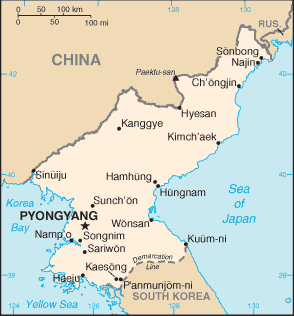
Persecution Update From North Korea

I am delaying my next post in my current series on my Danish experiences due to the fact that I will be naming some names and sharing some little known facts about my eviction from the Danish Pentecostal conference in 2008. I am still awaiting some verification of some correspondence and as such will not be posting until next week (hopefully). In the meantime, I thought it would be inspiring to share an article on something way more important than my petty travails - the persecuted church! Dr. Peter Hammond just sent me this story concerning the testimony of a girl from North Korea. North Korea is covered in a media blanket and we rarely get a eyewitness account from inside Kim Jong-Il's maniacal communist regime. So this story caught my radar - hopefully yours too!

FIRSTHAND TESTIMONY OF CHRISTIAN COURAGE AMIDST COMMUNIST PERSECUTION IN NORTH KOREA
One of the most moving presentations at the Cape Town 2010 Congress on World Evangelisation was presented by an 18 year old North Korean girl, Gyeong Ju Son.

Gyeong Ju Son was born in Pyongyang, the capital of North Korea. Her father was a high ranking communist government leader, an assistant to the North Korean leader Kim Jong-Il.

In 1998, when Gyeong Jun was only six years old, her father fell out of favour with the political leadership and the family fled to China. There her parents encountered the grace and love of God and were converted to Christ. A few months later her pregnant mother died of leukemia.

“It was in the midst of this family tragedy that my father joined a Bible Study led by missionaries from South Korea and America and after a time his strong desire was to become a missionary to North Korea.”

In 2001 her father was arrested by the Chinese police and deported to North Korea where he was imprisoned. Her father’s faith was only strengthened during his three year incarceration in North Korea. After Gyeong Ju Son was reunited with her father, he chose to return to North Korea. “Instead of enjoying a life of religious freedom in South Korea, he chose to return to North Korea to share Christ’s message of life and hope amongst the hopeless people of his homeland.”

In 2006 her father’s work was discovered by the North Korean communist government and once again he was imprisoned, and, as far as she knows, executed for refusing to renounce his faith in Christ.

In China, Gyeong Ju was adopted by a Christian family. Their love, compassion and protection of her made a deep impression. When they left for America she was given the opportunity to go to South Korea. While waiting at the South Korean Consulate in Beijing, Gyeong Ju’s life was dramatically changed when she encountered the Lord Jesus Christ in a dream. He said: “Walk with Me. Yes, you have lost your earthly father, but I am your Heavenly Father.”

She surrendered her heart, soul, mind and strength to the Lord Jesus Christ to do with as He will’s. She was flooded with a deep love for the lost people of North Korea and of the need to bring the message of Jesus to them. This became her life’s purpose. “I look back over my short life and I see God’s hand everywhere: 6 years in North Korea, 11 in China, and now in South Korea. Everything I suffered; all the sadness and grief, all that I have experienced and learned; I want to give it all to God and use my life for His Kingdom. In this way I also hope to bring honour to my father.”

Gyeong Ju Son is still a student and she intends to study political science and diplomacy at university and then to dedicate her life to working for the rights of the voiceless in North Korea.

“Brothers and Sisters here in this place, I humbly ask you to pray that the same light of God’s grace and mercy that reached my father and my mother and now me, will one day soon dawn upon the people of North Korea, my people.”

As one, the thousands of participants at the Cape Town 2010 Congress on World Evangelisation rose in a standing ovation with the most thunderous applause in praise to God, and in solidarity with this young Korean girl and her vision for reaching North Korea for Christ.

Saturday, October 9, 2010

Just Added - The Ten Commandments

This in depth unpacking and application of God's Holy Law has just been added to my resource directory.

THE TEN COMMANDMENTS
Peter Hammond

Category: Apologetics
Click Here To Order
This work by Dr. Peter Hammond is an invaluable resource for Discipleship and Reformation. Dr. Martin Luther declared: “the first duty of the Gospel preacher is to declare God’s Law and to show the nature of sin.” The Puritan author of Pilgrims Progress, John Bunyan, said: “A man who does not know the nature of the Law cannot know the nature of sin.” Charles Spurgeon declared: “They will never accept grace until they tremble before a just and Holy Law.” “Therefore the Law was our tutor to bring us to Christ, that we might be justified by faith” (Galatians 3:24). The Ten Commandments – God’s Perfect Law of Liberty identifies the contemporary idols for destruction and clearly shows, step by step, how we can seek first the Kingdom of God and His righteousness, applying the Lordship of Jesus Christ to all areas of life. “The Law of the Lord is perfect, converting the soul” (Psalm 19:7).

Here is what Ray Comfort had to say about this book:

Never before in Church history has there been such a need to return to the basics of Biblical evangelism. Our churches are filled with false converts, simply because we have abandoned doing what Jesus did when it comes to reaching out to the lost. The disease must be diagnosed before the cure is offered to the patient, or it will, understandably, never be appreciated or appropriated. I thank God for my friend Peter Hammond, and pray that God’s blessing will be on his book, The Ten Commandments - God’s Perfect Law of Liberty.

Wednesday, September 8, 2010

The Politically Incorrect Guide To Islam (Part 4)

It is no accident that the most vicious terrorism originates from the least evangelized area of the world. The Muslim Middle East represents the most complex political challenge, and potentially an enormous military threat, to the free world. It is also the greatest missionary challenge to the Church.

Muslim states are the most severe persecutors of Christians. And radical Muslim extremists are the most vicious terrorists, hijackers, kidnappers, suicide bombers, and assassins. The failure of the Christian Church to fulfill the Great Commission in the Middle East continues to have far-reaching and disastrous consequences.

Islam is a challenge that we cannot ignore. However, very few Christians understand Islam or know how to respond to it. (Peter Hammond p19 "Slavery, Terrorism, And Islam")


Go Back To Part 3
Go Back To Part 1

Wednesday, September 1, 2010

The Politically Incorrect Guide To Islam (Part 1)

Jesus healed the sick, Muhammed healed no-one. Jesus could make the blind see. Muhammed could only make the seeing blind. Jesus made the crippled walk. Muhammed could make the walking crippled. Jesus could take a dead man and make him alive. Muhammed could take a live man and make him dead. Jesus multiplied food to feed thousands. Muhammed could divide the loot among his followers. Jesus could walk on water. Muhammed could ride a camel. If you visit Medina you can visit the tomb where Muhammed is buried. But if you visit jerusalem you will find an empty tomb. The Lord Jesus Christ has risen. He is the way, the truth, and the life. No-one comes to the father except by Him. (Peter Hammond p94 Slavery, Terrorism, And Islam).

With the Mosque at ground zero controversy raging right now it is a good time to have a listen to Robert Spencer from Jihad Watch clear away the propoganda fog that swirls around Islam:


Go On To Part 2

Saturday, August 14, 2010

Just Added - The Power Of Prayer Handbook

This prayer handbook has just been added to my resource directory!

THE POWER OF PRAYER HANDBOOK
Peter Hammond

Category: Prayer
Click Here To Order
“Are you on fire for Christ? …. Lukewarm Christians make the Lord sick. We need to repent of half-hearted, worldly, superficial… easy believism. We need doctrinal steel in our backbones and Holy Fire in our bellies. ‘Is not My Word like a fire?’ says the Lord, ‘and a hammer that breaks the rocks in pieces?’” (Jeremiah 23:29) What can we say to that, except: Thank you Lord, for reminding us! Peter Hammond has illustrated his book with pictures of the Reformers and written it in a simple, warm, and direct way which speaks to the heart. It will make a great difference in our personal, Church, and national prayer life. Also includes a fascinating study on the imprecatory Psalms/prayers given from Dr. Hammond's insightful African perspective.

Friday, July 2, 2010

5 Days To Go - Reformation Resurrection 2010

Tilbage Til Bibelen (Back To Scripture) of Denmark is proud to host Dr Peter Hammond at this years Reformation Resurrection conference in Denmark. With 5 days to go (the conference runs from July 7th to 10th) we are almost fully booked but a handful of places remain.


Dr Hammond is one of the most exciting and gripping speakers I have ever heard. He is a rare blend of "tough as nails" frontier missionary, bold prophetic voice, and academic with peerless knowledge of Europe's Reformation history. Denmark rarely has visiting preachers of this caliber. If you are anywhere in the vicinity of Denmark - please don't miss out . . .

Click Here for all conference details.
Click here to view Dr. Hammonds CV.
Click here to watch a short interview of Dr. Hammond on "Wretched TV".
Click here to listen to Todd Friel interview Dr. Hammond.
Click here to download some of Dr. Hammond's sermons.

Wednesday, April 28, 2010

REFORMATION RESURRECTION 2010

Click Here To Check Out Our 2011 Conference


WHEN:
Wednesday July 7th through to Saturday July 10th 2010.

WHERE:
Hedemølle Boarding School
Hedemøllevej 31
8850 Bjerringbro
Denmark
(pictured to the right, scroll down to view an online map)

PRICE:
Prices include all food and accomodation.
Adults: 700 Danish Kroner (124 USD, 94 EUR, 82 GBP)
Students: 400 Danish Kroner ( 71 USD, 54 EUR, 47 GBP)
Ages 0-6: 150 Danish Kroner ( 27 USD, 20 EUR, 18 GBP)
Ages 7-14: 300 Danish Kroner ( 53 USD, 40 EUR, 35 GBP)
Ages 15-20: 400 Danish Kroner ( 71 USD, 54 EUR, 47 GBP)

SUBJECTS:
At Reformation Resurrection 2010, Dr. Peter Hammond will be teaching in subjects including the doctrine of justification, evangelism, biblical manhood and biblical womanhood, the Lord's day, and recount inspiring stories of the reformers themselves. Please don't miss this rare opportunity to be exposed to teaching and training of such high quality, biblical soundness, and fervent passion.

LANGUAGE:
All preaching and teaching for the duration of the conference will be in english. Some translation will be available.

CONTACT:
For further information and travel advice please e-mail
Henrik Mortensen
henrik.m@postkasse.net

The Tilbage Til Bibelen (Back to Scripture) network of Denmark is proud to present Reformation Resurrection 2010. Reformation Resurrection 2010 is a four day conference in the Danish countryside devoted to the furtherance of the Gospel in Europe and around the world. There is a lot of talk today about "new reformations" with new solutions to new problems. But we face the same problem today that we did 500 years ago - the pulpits of Europe have abandoned the Gospel. Reformation Resurrection 2010 is a rallying cry to the same solution that the reformers risked their lives to proclaim. That sinful men can be justified before a Holy God by grace alone, through faith alone, in Jesus Christ alone. And that this truth is faithfully proclaimed in God's Word alone, and to God's glory alone. The reformation isn't over - it just needs new life breathed into old truth. Men and women who are not ashamed of the glorious Gospel of Jesus Christ, the power of God unto salvation. Will you forsake the silence to join with us and be a voice in resurrecting the Reformation?

Europe has an amazing heritage of godly men and women who risked their lives for the proclamation of the Gospel and the preservation of the Bible. Thus it is entirely appropriate that this years guest speaker is no stranger to risking his life for the cause of Jesus Christ. Dr. Peter Hammond is a rare and diverse creature indeed. Trained as a soldier, educated as a historian and theologian, Dr. Hammond has been at the forefront of taking the Gospel into some of the most hostile places in Africa and around the world. It is no coincidence that the Sudanese government has a death warrant on this man when he repeatedly risks his life by travelling into the warzone of this hostile Islamic regime with the call to repentance and faith in Jesus Christ. He has been stabbed, shot at, bombed, and tortured all for the sake of the message he preaches. Dr. Hammond is also an historian of the highest order having written books on subjects like the Crusades, Inquisition, and of course the Reformation.

Click here to view Dr. Hammonds CV.
Click here to watch a short interview of Dr. Hammond on "Wretched TV".
Click here to listen to Todd Friel interview Dr. Hammond.
Click here to download some of Dr. Hammond's sermons.

Below you can view an online map of the campsite:


View Larger Map

Friday, March 12, 2010

What Every Christian Should Know About The Inquisition

While on the subject of Roman Catholicism in recent posts I thought it worthwhile to post this excellent article by Dr Peter Hammond telling the real story of the Inquisition . . .

One of the re-occurring accusations against Christianity is that Christians are responsible for: "The Inquisition!"

Frequently, while trying to love one’s neighbour and share the Gospel of our Lord Jesus Christ, Christians receive some tirade against "The Church" and "The Inquisition!" The Inquisition is used as some kind of general-purpose club with which to bludgeon Evangelical Christians.

On one occasion while I was being interviewed on a national secular radio programme, on the publication of my book: Biblical Principles for Africa, the first caller attacked me and my new book over something that the book doesn't even deal with - she claimed that Christians were responsible for “the Inquisition” which “burned thousands of witches!”

The Anti-Christian Inquisition
When I finally had the chance to respond to this emotional outburst, I had to point out that a vast majority burned at the stake by the Spanish Inquisition were not witches at all, but Protestant believers. Should one study the court records of the inquisitors it becomes very clear that the inquisitors were by no means Christians at all. They would vindictively condemn to death Christians who believed in, who translated, or who taught, the Holy Scriptures. Often the inquisitors contemptuously tossed the victim’s Bible into the fire to be burned with the martyr.

Anyone who has read Foxes Book of Martyrs, or similar historical records of the cruel persecutions endured by the Waldensians, the Huguenots and other Protestant reformers, will know that the Inquisition was anti-Christian. The Inquisition occurred at a time of blatant corruption, when priesthoods, bishoprics and even papal seats were bought and sold. There were many ungodly men dominating all levels of leadership in the medieval Roman church. Far from the Inquisition being Christians persecuting non-Christians, the reality is that it was the very opposite. The Inquisition was an anti-Christian persecution of Protestant believers.

The Judas Factor
The church has never been perfect. Even amongst the twelve Apostles there was a Judas Iscariot who betrayed Christ. Yet it would not be fair to make Judas a representative of the twelve Apostles! The total record of the church needs to be examined, and the good far outweighs the bad. Besides of which the Christian Faith is centered in Christ, not in Christians.

When someone brings up the question of evil perpetrated in God’s Name, we need to first examine whether the people involved were true Christians or not. Our Lord Jesus Christ made it abundantly clear: "Not everyone who says to Me, Lord, Lord, shall enter the Kingdom of Heaven, but he who does the will of My Father in Heaven. Many will say to Me in that day, Lord, Lord, have we not prophesied in Your Name, cast out demons in Your Name and done many wonders in Your Name, and then I will declare to them, I never knew you, depart from Me, you who practice lawlessness!" (Matthew 7:21-23)

Our Lord Jesus Christ made it clear that some people are truly part of His Church, the elect are all those who are regenerated by His Holy Spirit. However, not all of those in the larger, visible church are members of the true, invisible Church of Christ. The Lord warned that there would be weeds among the wheat and goats amongst His sheep. Many who claim to be Christians are not Christians at all.

The Historical Facts
When people bring up the Inquisition we need to ask them what they actually know about the Inquisition? Seldom has the individual done any research on the matter at all. The Spanish Inquisition began in the year AD1233. This is almost three hundred years before the Protestant Reformation. So, Protestants had no part in the Inquisition except as victims. Bible-believing, Evangelical Protestants were often on the receiving end of the Inquisition, tortured and killed for their beliefs. This included tens of thousands of Waldensian Christians tortured and murdered in the most brutal ways and the Lollards of England, the field workers of the Reformation, who were mercilessly persecuted. The English Reformer, William Tyndale, was burned at the stake in Belgium for the crime of having translated the Bible into the English language.

Protestants were burned at the stake as "heretics" in Spain, Italy, France, England and Scotland. Yet the Dutch Protestants suffered even worse persecutions at the hands of the Catholic Inquisition. Under King Phillip II of Spain, more than 18,000 Protestants were executed in the Netherlands. In an attempt to force them to confess to "heresy", both men and women were mercilessly tortured.

Excommunicating Holland
At that time, Spain was the most powerful country in the world. Holland was occupied by Spain. In 1566 Phillip II issued a proclamation demanding that all his subjects, accept the decrees made by the Council of Trent. Early in 1567, to crush the flourishing Protestant Faith in Holland, Phillip sent in the Duke of Alva, who unleashed a reign of terror upon the Dutch Protestants. In 1568 the Inquisition condemned all three million inhabitants of the Netherlands to death as "heretics".

Under the courageous leadership of William Prince of Orange, the Dutch Protestants rose up in resistance against the oppression of Catholic Spain. Prince William the Silent and his brave Dutch resistance fighters became the inspiration of Protestants world wide, particularly in England.

Bible Banned
After the Council of Valencia placed the Bible on The Index of Forbidden Books, in 1229, the papacy viciously persecuted the Waldensians. The hostility of the inquisitors to the Bible is clearly seen in their pronouncements such as in the condemnation of English Bible translator, Professor John Wycliffe of Oxford University: "Pestilent and most wretched John Wycliffe, of damnable memory ... crowned his wickedness by translating the Scriptures into the mother tongue!"

Similarly, the Inquisition condemned the Professor of Prague University, John Hus to be burned alive, for his Reformation works.

Foxes Book of Martyrs records the condemnation of prominent Protestant preacher, Reformer and Bible translator, John Rogers, who was burned at the stake, January 1555. Asked by the inquisitor to recant his beliefs, Rogers replied that what he had preached from the pulpit he would seal now with his blood.

"Then thou art an heretic!" exclaimed the inquisitor.

"That shall be known on the Day of Judgement," replied Rogers.

"Well, I will never pray for you", said his judge.

"I will pray for you", responded Rogers. As he walked to the stake in Smithfield, Rogers sang the Psalms.

On one day in 1519 seven men and women in Coventry were burned alive by the Inquisition for the crime of teaching their children: The Lords Prayer, The Ten Commandments and The Apostles Creed - in English!

At his trial, Bishop Ridley was urged to reject his Protestant Faith. His reply: "As for the doctrine which I have taught, my conscience assureth me that it is sound and according to God's Word ... in confirmation thereof I seal the same with my blood."

Blaming the Victims
Anyone attempting to blame Christians for the Inquisition is obviously ignorant of the historical record. It is an utter distortion to blame the victims for the tortures and murders, which were inflicted upon them. So, the next time non-Christians attempt to blame believers for the Inquisition, point out to them that in reality the Inquisition was an anti-Christian persecution of Protestant believers.

"Woe to those who call evil good; and good evil; who put darkness for light, and light for darkness..." Isaiah 5:20

Dr. Peter Hammond
Frontline Fellowship
P.O. Box 74
Newlands, 7725
Cape Town, South Africa
Tel: (021) 689-4480
Fax: (021) 685-5884
Email: admin@frontline.org.za
Website: www.frontline.org.za

Friday, February 19, 2010

What Every Christian Needs To Know About The Crusades (Part 2)

Continued from Wednesday by Dr. Peter Hammond . . .

A Reaction to Jihad

The crusaders were reacting to five centuries of relentless Islamic Jihad. The Middle East was the birthplace of the Christian Church. It was the Christians who had been conquered and oppressed by the Seljuk Turks. Many of the towns in the Middle East welcomed the crusaders as liberators.

Far from the crusaders being the aggressors, it was the Muslim armies which had spread Islam from Saudi Arabia across the whole of Christian North Africa into Spain and even France. Muslim armies sacked and slaughtered their way across some of the greatest Christian cities in the world, including Alexandria, Carthage, Antioch and Constantinople. These Muslim invaders destroyed over 3,200 Christian churches just in the first 100 years of Islam.

Against All Odds

When we think about the Middle Ages, we inevitably view Europe in the light of what it became rather than what it was. The fact is that the superpower of the Medieval world was Islam, not Christendom. The crusades were a battle against all odds with impossibly long lines of supply and cripplingly inadequate logistics. It was a David against Goliath enterprise from the beginning. The chances of success for the first crusade were highly improbable. They had no leader, no chain of command, no supply lines and no detailed strategy. The first crusade consisted simply of thousands of dedicated warriors marching deep into enemy territory, thousands of kilometres from home. Many of them died of starvation, disease and wounds. It was a rough campaign that always was on the brink of disaster. Yet by 1098, the Crusaders had liberated Nicea and Antioch, and in July 1099 they re-conquered Jerusalem.

Professor Madden, the author of A Concise History of the Crusades, has observed: “From the safe distance of many centuries, it is easy enough to scowl in disgust at the crusades. Religion, after all, is nothing to fight wars over. But we should be mindful that our Medieval ancestors would have been equally disgusted by our infinitely more destructive wars fought in the names of political ideologies…Whether we admire the Crusaders or not, it is a fact that the world we know today would not exist without their efforts. The ancient faith of Christianity, with its respect for women and antipathy toward slavery, not only survived but flourished. Without the crusades, it might have followed Zoroastrianism, another of Islam’s rivals, into extinction.” But for the crusades Europe would have probably fallen to Islam and the USA and South Africa would never have come into existence.

Logistics and Economics

As the Christian History Institute has pointed out, the characterising of crusaders as only in it for the plunder and the loot betrays an ignorance of both geography and history. The vast majority of the crusaders were impoverished and financially ruined by the crusades. Crusaders, through great sacrifice and personal expense, left their homes and families to travel 3000km across treacherous and inhospitable terrain – and the shortest crusade lasted 4 years. Considering that only 10% of the crusaders had horses, and 90% were foot soldiers, the sheer fact of logistics is that the crusaders could not possibly have carried back enough loot to have made up for the loss of earnings and high expenses involved with these long crusades. Many crusaders lost their homes and farms to finance their involvement in the crusades.

There’s More to Life than Money

Perhaps self-seeking materialistic agnostics in the 21st Century cannot understand that some people could be motivated by something other than personal financial enrichment, but the fact is that many people make sacrifices for their religious convictions, and in order to help others. In the case of the crusaders, the historical record makes clear that amongst the motivations that led tens of thousands of volunteers to reclaim the Holy Land was a sense of Christian duty to help their fellow Christians in the East whose lands had been invaded and churches desecrated by Muslim armies, and a desire to secure access to the Holy Lands for pilgrims.

There was also a desire to fight for the honour of their Lord Jesus Christ, Whose churches had been destroyed and Whose Deity had been denied by the Mohammadan aggressors. In other words, to the crusaders this was a defensive war to reclaim Christian lands from Muslim invaders.

We may not share their convictions, or agree with their methods, but we ought to evaluate them in the light of the realities of the 11th and 12th centuries, and not anachronistically project our standards and politics back upon them.

Jihad Vs. The Gospel

The word “crusade” does not appear in the Bible, nor is it commanded in Christianity. However, Jihad is the sixth pillar of Islam and the second greatest command of Muhammad. It is not only commended, but commanded in the Quran.

The crusades ended many centuries ago, however Islamic Jihad is carried out to this day. Millions of Christians have been slaughtered throughout the centuries by Islamic militants – such as the 1.5 million Armenians murdered in Turkey in 1915. Christians have continued to be slaughtered by Islamic militants in Indonesia, the Philippines, Sudan and Nigeria to the present day.

Therefore, before Christians fall over themselves to apologise for the crusades, which ended over 700 years ago, it would be wise to first learn from reliable sources what the crusades were all about, and study the Islamic teachings and track record of Jihad over the last 14 centuries. Those who do not know their past have no future.

Dr. Peter Hammond has been a pioneer missionary to Muslims in Sudan. He is the author of Slavery, Terrorism and Islam – The Historical Roots and Contemporary Threat.

Go Back To Part 1