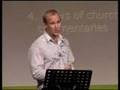
Niels Christian Hvidt is a Catholic academic and theologian who lives in Denmark. Fluent in many languages, he has published numerous books, and did his theological doctorate at the Gregorian University in Rome. His Doctoral Thesis "Christian Prophecy - Its Preconditions, Function, and Status in the Church" was published by Oxford University Press. He is clearly a brilliant man, and as someone who has lectured at two Pontifical Universities in Rome, he would have to be well acquainted with the theological differences that gave birth to Protestantism.
I talk about Niels Christian Hvidt today because he serves as a great example of Roman Catholics who want to have a "foot in each camp" by gaining acceptance to teach in both Catholic and Evangelical churches. As we established in my previous post, Catholicism and Christianity are two seperate religions with two different gospels. Biblical Christianity teaches in accordance with Ephesians 2:8 that salvation hinges on faith in Christ apart from any works. Catholicism, on the other hand, pronounces damnation on this Christian view of salvation, requiring faith plus human works in order for people to receive salvation. It is simply not intellectually honest to sweep this difference under the carpet as a secondary issue. But that is precisely what happens when you have evangelical leaders who think that the purity of the Gospel is something not worth defending, ecumenicals who sacrifice truth at the altar of unity, and articulate Catholic diplomats who are expert in avoiding these issues altogether.
 Niels Christian Hvidt has gained widespread acceptance with Catholics and Evangelicals in Denmark through actively teaching in miracles (including Marian apparitions and stigmata). I thought it reasonable to question Hvidt on where he stands on the doctrine of Justification. Some have accused me of having an agenda to expose him as a false teacher. My agenda has always been simply this, give him a chance to state his position on Justification so that the general church going public knows where he stands and where his allegiance lays. We must all take a side on this issue and it is intellectually dishonest to suggest that you can hold to both the reformed view of Justification and to the Council of Trent.
There was an online dialogue initiated by a friend of mine called Carsten Joergensen after he was unable to get Hvidt to give him a straight answer on Justification through private correspondance. The online dialogue was offensive to Hvidt because he thought that it was a trap with many other questions to follow. Although Niels Christian Hvidt displayed great reluctance to take a stance on Justification, he affirmed it without renouncing Trent. This, of course, left us back where we started.
What follows is a recent letter I sent to Niels Christian Hvidt, hoping to reason with him, and that he would man up and take a stand one way or the other. See what you think?
Dear Niels Christian Hvidt,
My name is Cameron Buettel and I am a good friend of Carsten Joergensen. I have been watching the online dialog with interest between you.
From my conversations with Carsten it seems that you think this question he is asking is the tip of the iceberg. Actually it is the entire iceberg.
I share with Carsten the conviction that the doctrine of justification remains the great gulf that seperates Roman Catholicism from Christianity. We don't object to you teaching in Catholic congregations, nor do we necessarily object to you teaching in evangelical Christian churches. But we do object to anyone who wants to do both of these - as it seems you are doing. There is no hidden agenda here - no scary monster waiting behind the curtains. The fundamental issue of how men are saved puts Catholics and Christians in different camps to this very day. I am well aware of all the joint declarations but they bear no relevance as long as the council of Trent still stands.
Please have some respect for our concerns. I think it is shameful if no one else has challenged you over these issues. The council of Trent pronounces Anathema on orthodox Christians who entrust the salvation of our souls by grace alone, through faith alone, in Christ alone.
"If any one saith, that by faith alone the impious is justified; in such wise as to mean, that nothing else is required to co-operate in order to the obtaining the grace of Justification, and that it is not in any way necessary, that he be prepared and disposed by the movement of his own will; let him be anathema" (Council of Trent, Canons on Justification, Canon 9).
Niels Christian, we all know that this Canon still stands. What I am saying is that one cannot embrace salvation by grace alone through faith alone in Christ alone without renouncing the abovementioned Canon. I agree that this is a dilemna which is why, in the interest of intellectual honesty and integrity, we want you to state which side of this doctrine you fall on. A yes (as you have given) answer on the omvendelse blog is perfectly acceptable provided the converse is true - that you renounce Council of Trent, Canons on Justification, Canon 9.
Neither of us are unreasonable men. We are brothers in Christ. Wretched undeserving sinners saved by a very kind God Who credited His righteousness to us through Christ's atoning work on the cross. We are people who actively witness and share the Christian Gospel with the lost and are well aware of the enormous damage done by any works righteous religious system when people entrust their eternity to anything other than (or in addition to) Christ - and Roman Catholicism is one of those works righteous systems.
Justification has been merited for us by the Passion of Christ. It is granted to us through Baptism. It conforms us to the righteousness of God, who justifies us. It has for its goal the glory of God and of Christ, and the gift of eternal life. It is the most excellent work of God's mercy (CCC, par. 2020).
We can therefore hope in the glory of heaven promised by God to those who love him and do his will. In every circumstance, each one of us should hope, with the grace of God, to persevere to the end and to obtain the joy of heaven, as God' eternal reward for the good works accomplished with the grace of Christ (CCC, par. 1821).
This is not a conspiracy, we care about the purity of the Gospel as can be seen by the doctrine statement we hold to. We do not doubt that you could teach us many things of value as you are very learned. But the average church goer needs to know that there are fundamental differences between Roman Catholicism and Christianity - and that these differences are large enough for Catholicism to fall outside the bounds of orhtodox historic Christianity. I applaud the Pope for his honesty when he stated in the document (http://www.vatican.va/roman_curia/congregations/cfaith/documents/rc_con_cfaith_doc_20070629_responsa-quaestiones_en.html)
"Christ “established here on earth” only one Church and instituted it as a “visible and spiritual community”, that from its beginning and throughout the centuries has always existed and will always exist, and in which alone are found all the elements that Christ himself instituted. “This one Church of Christ, which we confess in the Creed as one, holy, catholic and apostolic […]. This Church, constituted and organised in this world as a society, subsists in the Catholic Church, governed by the successor of Peter and the Bishops in communion with him”."
And he describes protestant churches thusly:
"According to Catholic doctrine, these Communities do not enjoy apostolic succession in the sacrament of Orders, and are, therefore, deprived of a constitutive element of the Church. These ecclesial Communities which, specifically because of the absence of the sacramental priesthood, have not preserved the genuine and integral substance of the Eucharistic Mystery cannot, according to Catholic doctrine, be called “Churches” in the proper sense."
I don't have a problem with the Pope. I regard him as a heretic, but at least he is saying things consistent with Roman Catholic doctrine.
We can always agree to disagree in love, but let us not deceive ourselves that we agree on the things we don't. You are always welcome to e-mail or phone me and speak personally or do lunch.
Thank you for taking the time to read this mail.
Sincerely
Cameron Buettel
Go Back To My Previous Post On Catholicism