Showing posts with label JI Packer. Show all posts

Monday, November 14, 2011

Phil Johnson, Todd Friel, And Another Elephant In The Room

I have refrained from commenting thus far on the much debated Elephant Room conference. The Elephant room conference is a concept developed by Pastor James MacDonald which, in the words of the conference website:

Getting brothers together who believe in salvation by grace alone through faith alone but normally don't interact, is what the Elephant Room is all about.

The idea is to get Christians together who agree on the Gospel but have major methodological differences, and thrash out those differences in a no holds barred public conversation. I think it would be fair to say that MacDonald is trying to give off a combative vibe about the conference when people are invited to "get their ringside seats".

I think the concept has a lot of merit in principle and I have always liked James MacDonald and the content of his preaching. I think people like Mark Driscoll, Francis Chan, and Matt Chandler are the perfect candidates for a brotherly debate on methodology. But I took issue with the first Elephant Room conference earlier this year because, I would contend, there was another elephant in the room. When MacDonald invited wannabe rock star pastor Steven Furtick and wannabe tough guy pastor Perry Noble I was quite shocked. I would think that a lot of other things need to be discussed with these guys before we talk about methodology. What about the Gospel elephant in the room? And what about the way they speak to their sheep? (Though I do find the thought of speaking with Steven Furtick without the interference of one of his bodyguards quite appealing.) When Perry Noble has ACDC's Highway To Hell as part of his worship service I think the problems go way deeper than song selection. This all just seemed so beneath Pastor James MacDonald. Many of us scratched our heads and just chalked it up as one of those strange things akin to JI Packer signing the ECT (Evangelicals and Catholics Together statement) or John Piper's association with Rick Warren.

But when MacDonald announced Elephant Room 2 (the sequel) and said that TD Jakes would be one of the guests a cyber volcano erupted. A lot of respected theological heavyweights weighed in with very sharp responses. MacDonald does not seem to have taken the criticism especially well but has softened somewhat more recently. But the way he has dealt with the opposition to his invitation of a well known anti-Trinitarian heretic (and that is just one of the myriad of problems with Jakes prosperity man centered theology - see the video at the bottom of this post) by changing the vision statement from "getting brothers together" to "conversation among all kinds of leaders". I seriously question this kind of solution to a problem of this magnitude.

Todd Friel publicly questioned Phil Johnson on this very subject recently and I am grateful that someone was around to video this fascinating conversation. It is 43 minutes long but well worth the listen because Johnson's insights really get to the core of this issue and discernment in general. This is an interesting discussion that would be exceedingly appropriate for the Elephant Room (without the need to buy "ringside" seats):

Saturday, January 29, 2011

Just Added - Knowing God

JI Packer's classic work has just been added to my resource directory! Yes I know Packer signed onto the ECT document and I hope he repents of that. In fact, the theology reflected in this book rebukes Packer's actions in signing the ECT.

KNOWING GOD
J I Packer

Category: Apologetics, Theology
Click Here To Order
A lifelong pursuit of knowing God should embody the Christian's existence. According to eminent theologian J.I. Packer, however, Christians have become enchanted by modern skepticism and have joined the "gigantic conspiracy of misdirection" by failing to put first things first. Knowing God aims to redirect our attention to the simple, deep truth that to know God is to love His Word. What began as a number of consecutive articles angled for "honest, no-nonsense readers who were fed up with facile Christian verbiage" in 1973, Knowing God has become a contemporary classic by creating "small studies out of great subjects." Each chapter is so specific in focus (covering topics such as the trinity, election, God's wrath, and God's sovereignty), that each succeeding chapter's theology seems to rival the next, until one's mind is so expanded that one's entire view of God has changed. The lazy and faint-hearted should be warned about this timeless work - God is magnified, the sinner is humbled, and the saint encouraged.

Wednesday, February 24, 2010

Why NT Wright Is Wrong

NT Wright, the Bishop of Durham, enjoys tremendous popularity among "thinking Christians". He is even getting a foothold in the secular bookstores, as evidenced by finding his latest book on display at the front of a Barnes and Noble store I recently visited. This has prompted me to write a post about him as he has not been previously discussed on this blog.

It is true that Wright's landmark book "The Resurrection of the Son of God" is widely recognized as an outstanding defense of Christ's bodily resurrection. Getting the resurrection right seems to have opened a lot of people's receptivity to Wright's subsequent books where he discusses the cross, justification, and penal substitutionary atonement (Wright even endorsed Steve Chalkes book in which Chalke described the doctrine of penal substitutionary atonement as "cosmic child abuse"). Many reformed theologians have been greatly disturbed by the theology that NT Wright's subsequent works have revealed. It may well be that Wright's scholarly defense of the resurrection turns out to be a scholarly trojan horse concealing destructive heresies.

At the heart of Wright's many troubling ideas lies his view of the doctrine of justification, particularly the component of imputed righteousness. Over and over again, Wright attacks the classic Reformed and biblical doctrine that the righteousness of Christ is imputed, or reckoned, to the sinner's account, and it is on the ground of Christ's righteousness alone that we obtain our righteous standing before God. Wright says:

If we use the language of the law court, it makes no sense whatsoever to say that the judge imputes, imparts, bequeaths, conveys or otherwise transfers his righteousness to either the plaintiff or the defendant. Righteousness is not an object, a substance or a gas which can be passed across the courtroom . . . If we leave the notion of 'righteousness' as a law-court metaphor only, as so many have done in the past, this gives the impression of a legal transaction, a cold piece of business, almost a trick of thought performed by a God who is logical and correct but hardly one we would want to worship (p98 What St Paul Really Said).

Phil Johnson responded to these exact comments in a sermon by saying "Well, I, for one, am quite happy to worship a God who justifies the ungodly and who is both just and the justifier of the one who believes in Jesus."

John Macarthur has this to say about the importance of getting imputation right:

The cornerstone of justification is the reckoning of righteousness to the believer's account. This is the truth that sets Christian doctrine apart from every form of false religion. We call it "imputed righteousness". Apart from it salvation is utterly impossible (p197 The Gospel According to Jesus).

Here is an excerpt from an interview RC Sproul had with Michael Horton discussing the theology of N.T. Wright.

[Q] Considering Bishop N.T. Wright’s doctrine of justification, do you believe he is teaching another gospel?

[A] J.I. Packer has a great line: Tom Wright foregrounds what the Bible backgrounds, and backgrounds what the Bible foregrounds–but Wright does more than that; he denies a crucial component of justification, namely imputation. So, in answer to your question, yes–in denying imputation, Wright is preaching another gospel.

There’s a kind of fundamentalist approach to Scripture that Tom Wright seems to want to confront. And while he does a wonderful job of highlighting the fact that justification in Paul’s writings is understood within a broader redemptive-historical framework, something not all presentations and defenses of justification do, he is not confronting historic Reformed theology. Reformed theology always has understood justification within a broader redemptive-historical framework. If he were to read the Reformers and more recent Reformed writers, such as Geerhardus Vos and Herman Ridderbos, he would clearly see that justification is placed in its proper context with the believer’s union with Christ and within the whole history of redemption. Reformed writers speak of Paul’s treatment of justification being inseparable from the inclusion of the Gentiles. Then, when you read Tom Wright he makes it seem as if he’s the first person who saw these emphases of Paul, and that everyone else before him sort of taught the four spiritual laws. It’s an incredibly naïve view.

I know Tom Wright–not well, but we had a few conversations in my Oxford days; we’ve gone back and forth about these issues, and he simply doesn’t know historical theology. He’ll actually admit that when you catch him at a few points; he’ll say something along the lines of “well this really isn’t my area of expertise.” Well, if your thesis is that the Reformation fundamentally misunderstood Paul, it better be your area of expertise to at least know what the Reformers said–and he doesn’t. So, Wright creates a straw man. And the people who are swayed by him, who are enamored of him, are also in many cases ignorant of what the Reformers actually taught, what Reformed theology has taught on these matters. And let me offer an impassioned plea to folks: There are Reformed presentations of the doctrine of justification that include some of the very salient points that Tom Wright has raised and incorporated, without denying the very crucial component of imputation as Tom Wright does. Without imputation, justification isn’t good news. When he says that the Gospel is “Jesus is Lord,” I reply, there are many passages that tell me “Jesus is Lord” isn’t good news. There are many passages that tell me “Jesus is Lord” means to a whole lot of people “the great Avenger on the white horse with a sword in His hand, bringing the last judgment.” “Jesus is Lord” means that He will be your judge. On Mars Hill in Athens, Paul said there is a judgment coming, a last judgment coming, and God has given proof of this to everyone by raising Jesus from the dead. So Jesus is Lord is not necessarily good news. Only when God assures me that I am in Christ by grace alone through faith alone and kept by grace is the announcement “Jesus is Lord” good news rather than the worst possible news (online source).

It is worth noting that many false teachers survive on the basis of their lack of clarity. We tend to give people the benefit of the doubt when they speak in a foggy and unclear manner. NT Wright has become (unwittingly perhaps) the Mr Miyagi of the emergent movement for this reason. Wright communicates a different gospel in a way that is obscure enough not to be pinned down outside of orthodoxy. He is the master of answering questions by cutting a short story long and burying the initial question in the process. With this in mind, I have found a good rule of thumb when choosing our feeding grounds for Christian teaching. Sound biblical teachers are aways explicitly clear about the fundamental truths of the Christian faith. Choose feeding grounds that communicate the Gospel faithfully, accurately, and clearly.

Sunday, August 9, 2009

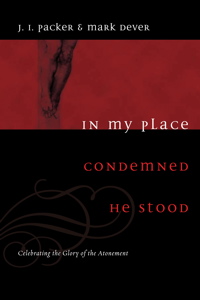
In My Place Condemned He Stood

I am currently reading the book "In My Place Condemned He Stood" by JI Packer and Mark Dever and it is just loaded with powerful truths about the Cross and what it is really all about. On this Sunday, the Lord's day, what better thing to do than to meditate on the Cross of Christ and what it means, namely Penal Substitutionary Atonement (a doctrine currently under deceptive attack by emergents, liberals, and some "church growth" exponents). You are about to be blessed with some precious insight from the pen of JI Packer:

How then did the cross actually redeem us, through Jesus' death? By reconciling us to God, ending the alienation and estrangement that were previously there, linking God and us together in new harmony, replacing enmity between us with friendship and peace, by means of the putting away of our sins (Rom 5:11, Col 1:19-22).

So how did the cross actually reconcile us to God, and God to us? By being a propitiation, ending God's judicial wrath against us (Rom 3:24).

And how did the cross actually propitiate God? By being an event of substitution, whereby at the Father's will the sinless Son bore the retribution due to us guilty ones (2Cor 5:21, Gal 3:13, Col 2:14).

For Paul, this substitution, Christ bearing our penalty in our place, is the essence of the atonement. Certainly, he celebrates the cross as a victory over the forces of evil on our behalf (Col 2:15) and as a motivating revelation of the love of God toward us (2Cor 5:14-15), but if it had not been an event of penal substitution, it would not for him have been either of these. As Galatians 2:20 declares, his life of responsive faith was wholly formed and driven by the knowledge that his Savior had revealed divine love to him by giving Himself to die on the cross in order to save him.

Accordingly, this text starts to show us how faith in Christ, our penal substitute, should be shaping our own lives today. Here is my analysis of insights basic to personal religion that faith in Christ as one's penal substitute yields.

1. God, in Denney's phrase, "condones nothing", but judges all sin as it deserves: which Scripture affirms, and my conscience confirms, to be right.
2. My sins merit ultimate penal suffering and rejection from God's presence (conscience also confirms this), and nothing I do can blot them out.
3. The penalty due to me for my sins, whatever it was, was paid for me by Jesus Christ, the Son of God, in His death on the cross.
4. Because this is so, I thorugh faith in Him am made "the righteousness of God in Him", ie, I am justified; pardon, acceptance, and sonship to God, become mine.
5. Christ's death for me is my sole ground of hope before God. "If He fulfilled not justice, I must; if He underwent not wrath, I must to eternity" (John Owen).
6. My faith in Christ is god's own gift to me, given in virture of Christ's death for me.
7. Christ's death for me guarantees my preservation to glory.
8. Christ's death for me is the measure and pledge of the love of the Father and the Son to me.
9. Christ's death for me calls and constrains me to trust, to worship, to love and to serve.

Only when these nine truths have taken root and grow in the heart will anyone be fully alive to God.

A lawyer, having completed his argument, may declare that here he rests his case. I, having surveyed the penal substitutionary sacrifice of Christ afresh, now reaffirm that here I rest my hope. So, I believe, will all truly faithful believers.

In recent years great strides in biblical theology and contemporary canonical exegesis have brought new precision to our grasp of the Bible's overall story of how God's plan to bless Israel, and through Israel the world, came to it's climax in and through Christ. But I do not see how it can be denied that each New Testamant book, whatever other job it may be doing, has in view, one way or another, Luther's primary question: how may a weak, perverse, and guilty sinner find a gracious God? Nor can it be denied that real Christianity only really starts when that discovery is made. And to the extent that modern developments, by filling our horizon with the great metanarrative, distract us from pursuing Luther's question in personal terms, they hinder as well as help in our appreciation of the gospel.

The church is and will always be at its healthiest when every Christian can line up with every other Christian to sing PP Bliss's simple words:

Bearing shame and scoffing rude
In my place condemned He stood,
Sealed my pardon with His blood -
Hallelujah! What a Saviour!

Sunday, March 16, 2008

RECOMMENDED BOOKS - J I PACKER

Noted Bible scholar and author James I. Packer is currently a professor of theology at Regent College in Vancouver, British Columbia. He has authored the classic bestseller Knowing God, as well as a number of other titles. Most recently, he served as General Editor for the English Standard Version Bible, published by Crossway Bibles. Packer is an outstanding defender of Penal Substitutionary Atonement and is an author I highly recommend although a caution is necessary due to Packer's signing of the "Evangelicals Catholics Together" (ECT) document of which many Christians hope he will recant.


IN MY PLACE CONDEMNED HE STOOD
J I Packer, Mark Dever

Category: Theology, Heroes, Puritans, And Reformers
Click Here To Order
An important anthology that reaffirms the classic doctrine of substitutionary atonement and counters the ongoing attacks against it. If ever there was a time and a need for an enthusiastic reaffirmation of the biblical doctrine of substitutionary atonement, it is now. With this foundational tenet under widespread attack, J. I. Packer and Mark Dever’s anthology plays an important role, issuing a clarion call to readers to stand firm in the truth. In My Place Condemned He Stood combines three classic articles by Packer—“The Heart of the Gospel”; his Tyndale Biblical Theology Lecture, “What Did the Cross Achieve”; and his introductory essay to John Owen’s The Death of Death in the Death of Christ—with Dever’s recent article, “Nothing but the Blood.” It also includes an outstanding bibliography compiled by Ligon Duncan.


KNOWING GOD
J I Packer

Category: Apologetics, Theology
Click Here To Order
A lifelong pursuit of knowing God should embody the Christian's existence. According to eminent theologian J.I. Packer, however, Christians have become enchanted by modern skepticism and have joined the "gigantic conspiracy of misdirection" by failing to put first things first. Knowing God aims to redirect our attention to the simple, deep truth that to know God is to love His Word. What began as a number of consecutive articles angled for "honest, no-nonsense readers who were fed up with facile Christian verbiage" in 1973, Knowing God has become a contemporary classic by creating "small studies out of great subjects." Each chapter is so specific in focus (covering topics such as the trinity, election, God's wrath, and God's sovereignty), that each succeeding chapter's theology seems to rival the next, until one's mind is so expanded that one's entire view of God has changed. The lazy and faint-hearted should be warned about this timeless work - God is magnified, the sinner is humbled, and the saint encouraged.