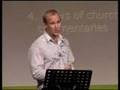
During my visit to the USA earlier this year I had the great priveledge of interviewing Phil Johnson. For those of you who don't know, Phil is a thundering preacher with a sharp satirical wit who serves alongside John Macarthur at Grace Community Church in Sun Valley, California. This satirical wit gets ably demonstrated on his immensly popular blog - Pyromaniacs - which is a rich blend of satire and reformed theology. Phil is also one of the world's foremost authorities on the great 19th century preacher Charles Spurgeon and runs the online Spurgeon Archive which contains almost anything and everything regarding the "prince of preachers". Phil Johnson is an outstanding and well researched Christian apologist and I was thrilled at the opportunity to ask him some questions.
In this first part of the interview I ask Phil Johnson about NT Wright and "The New Perspective on Paul". If you read much of NT Wright's work you will realize that he has had an enormous influence on most of the main teachers within the emergent movement, particularly concerning the Atonement. A lot of what Wright says and teaches is alarming and yet ambiguous enough for him to survive as a respected "evangelical Christian". Phil Johnson has done his homework on this subject and has some sharp things to say (which serve as a sharp contrast to the second rate cameraman).
Go On To Part 2
Showing posts with label NT Wright v The Gospel. Show all posts
Showing posts with label NT Wright v The Gospel. Show all posts
Monday, August 23, 2010


Friday, May 7, 2010
NT Wright v RC Sproul
 The latest edition of Tabletalk Magazine features an array of theological heavyweights taking aim at NT Wright and his new perspective on Paul (ok, I know NT Wright is not the originator, but he is the one gaining traction). I discovered this only after writing my recent series on "NT Wright v the Gospel". It serves as strong confirmation that NT Wright's writings and teachings are gaining a substantial corrupting foothold in the wider "church community".
 When it comes to reformed theology, the authority of Scripture, and the purity of the Gospel, RC Sproul would be at the top end of the heavyweights. Some of his books, including "The Holiness of God" are classic landmark Christian literature. For decades Sproul has been an ardent contender for the once for all delivered faith. So it was with great interest that I read his response to NT Wright and the "new perspective". Sproul harnesses years of experience and biblical awareness to cut through the fog of Wright's assertion that he can do a better job of explaining the Apostle Paul than the Apostle himself (that's my cheeky paraphrase anyway). What follows is RC Sproul's response:
 Tilting at Scarecrows
by R.C. Sproul
“We are not justified by faith by believing in justification by faith. We are justified by faith by believing in the gospel itself—in other words, that Jesus is Lord and that God raised him from the dead.”
(N.T. Wright, “New Perspectives on Paul,” p 261)
In the past few years, the British bishop and New Testament scholar N.T. Wright has emerged as an icon of biblical theology around the world. His excellent work on the resurrection of Christ has influenced many people including his own country’s most famous philosopher and former atheist Antony Flew, who has converted to deism. Wright is also known, however, for being one of the chief architects of the so-called new perspective on Paul, in which he recasts the doctrine of justification in such a way as to transcend the historic dispute between Roman Catholicism and Reformation Protestantism. In a sense, Wright says, “A pox on both your houses,” claiming that both Rome and the Reformation misunderstood and distorted the biblical view of justification. In his response to John Piper’s critique of his work, Wright drips patronizing disdain for Piper and for those who embrace the traditional Protestant view of justification. He is critical of theological traditions that he thinks miss the biblical point.
In the course of debate, one of the most effective and fallacious arguments often used is called the “straw man” fallacy. The value of a scarecrow is that it is a counterfeit human being designed to scare away a few crows. It is an effective device, but not nearly as effective as a real farmer patrolling his fields with a shotgun. The farmer made of straw is not nearly as formidable as the real one. This is usually the case in the difference between the authentic and the counterfeit. The straw man fallacy occurs when one creates a false view of his opponent’s position in a distorted caricature by which he then easily dismantles that position in total refutation.
One of the statements that N.T. Wright employs, using this same stratagem, is the statement that “we are not justified by faith by believing in justification by faith.” To intimate that Protestant orthodoxy believes that we are justified by believing in the doctrine of justification by faith is the king of all straw men. It is the Goliath of scarecrows, the King Kong of straw man fallacies. In other words, it is a whopper. I am aware of no theologian in the history of the Reformed tradition who believes or argues that a person can be justified by believing in the doctrine of justification by faith. This is a pure and simple distortion of the Reformed tradition.
 In Wright’s statement we see a straw man argument that falls by its own weight. It contains more straw than the stick figure can support. The doctrine of justification by faith alone not only does not teach that justification is by believing in the doctrine of justification by faith alone, but in fact, teaches that which is totally antithetical to the idea. The phrase “justification by faith alone” is theological shorthand for saying justification is by Christ alone. Anyone who understands and advocates the doctrine of justification by faith alone knows that the focal point is that which justifies — trust in Christ and not trust in a doctrine.
One of the key terms in the phrase “justification by faith” is the word by, which signals that faith is the means or tool that links us to Christ and His benefits. The concept indicates that faith is the “instrumental” cause of our justification. What is in view in the Protestant formulation is a distinction from the Roman Catholic view of the instrumental cause. Rome declares the sacrament of baptism in the first instance and penance in the second instance to be the instrumental causes of justification. So the dispute of what instrument is the basis by which we are justified was and remains critical to the classical dispute between Rome and Protestantism. The Protestant view, following Paul’s teaching in the New Testament, is that faith is the sole instrument by which we are linked to Christ.
Closely related to this is the hotly disputed issue of the grounds of our justification before God. Here is where the biblical concept of imputation is so important. Those who deny imputation as the grounds of our justification declare it to be a legal fiction, a miscarriage of justice, or even a manifestation of cosmic child abuse. Yet at the same time, it is the biblical explanation for the ground of our redemption. No biblical text more clearly teaches this concept of transfer or imputation than that of Isaiah 53, which the New Testament church singled out as a crucial prophetic explanation of the drama of redemption. The New Testament declares Christ to be our righteousness, and it is precisely our confidence in the righteousness of Christ as the grounds for our justification that is the focus of the doctrine of justification by faith. We understand that believing the doctrine of sola fide will save no one. Faith in a doctrine is not enough to save. However, though we cannot be saved by believing in the doctrine of justification, the denial of that same doctrine can indeed be fatal because to deny the doctrine of justification by faith alone as the apostle Paul indicated in Galatians is to reject the gospel and substitute something else for it, which would result in what Paul declares to be anathema. The gospel is too important to be dismissed by tilting at scarecrows.
Go Back To NT Wright v The Gospel
Wednesday, May 5, 2010
NT Wright v The Gospel (Part 3)
 As we saw in part 2 of this series, NT Wright says he believes in Penal Substitutionary Atonement (PSA). But the PSA that Wright believes in is just like the jesus that the Mormons believe in - a phony, a product of their own imaginations and not found in Scripture. But Wright's gross error on PSA and the Gospel continues to manifest itself in his understanding of the doctrine of imputation:
If we use the language of the law court, it makes no sense whatsoever to say that the judge imputes, imparts, bequeaths, conveys or otherwise transfers his righteousness to either the plaintiff or the defendant. Righteousness is not an object, a substance or a gas which can be passed across the courtroom . . . If we leave the notion of 'righteousness' as a law-court metaphor only, as so many have done in the past, this gives the impression of a legal transaction, a cold piece of business, almost a trick of thought performed by a God who is logical and correct but hardly one we would want to worship (p98 What St Paul Really Said).
What God’s righteousness never becomes, in the Jewish background which Paul is so richly summing up, is an attribute which is passed on to, reckoned to, or imputed to, his people. Nor does Paul treat it in this way. (http://www.ntwrightpage.com/Wright_New_Perspectives.htm).
Hmmm
For what saith the scripture? Abraham believed God, and it was counted unto him for righteousness. Now to him that worketh is the reward not reckoned of grace, but of debt. But to him that worketh not, but believeth on him that justifieth the ungodly, his faith is counted for righteousness. Even as David also describeth the blessedness of the man, unto whom God imputeth righteousness without works, Saying, Blessed are they whose iniquities are forgiven, and whose sins are covered. Blessed is the man to whom the Lord will not impute sin (Romans 4:3-8).
John Macarthur has this to say about the importance of getting imputation right:
The cornerstone of justification is the reckoning of righteousness to the believer's account. This is the truth that sets Christian doctrine apart from every form of false religion. We call it "imputed righteousness". Apart from it salvation is utterly impossible (p197 The Gospel According to Jesus).
But the problems don't end here. Wright confuses justification with sanctification, and salvation with eternal rewards:
Paul, in company with mainstream second-Temple Judaism, affirms that God’s final judgment will be in accordance with the entirety of a life led – in accordance, in other words, with works . . . I am fascinated by the way in which some of those most conscious of their reformation heritage shy away from Paul’s clear statements about future judgment according to works. It is not often enough remarked upon, for instance, that in the Thessalonian letters, and in Philippians, he looks ahead to the coming day of judgment and sees God’s favourable verdict not on the basis of the merits and death of Christ, not because like Lord Hailsham he simply casts himself on the mercy of the judge, but on the basis of his apostolic work. ‘What is our hope and joy and crown of boasting before our Lord Jesus Christ at his royal appearing? Is it not you? For you are our glory and our joy.’ (1 Thess. 3.19f.; cp. Phil. 2.16f.) I suspect that if you or I were to say such a thing, we could expect a swift rebuke of ‘nothing in my hand I bring, simply to thy cross I cling’. The fact that Paul does not feel obliged at every point to say this shows, I think, that he is not as concerned as we are about the danger of speaking of the things he himself has done – though sometimes, to be sure, he adds a rider, which proves my point, that it is not his own energy but that which God gives and inspires within him (1 Cor. 15.10; Col. 1.29). But he is still clear that the things he does in the present, by moral and physical effort, will count to his credit on the last day, precisely because they are the effective signs that the Spirit of the living Christ has been at work in him. We are embarrassed about saying this kind of thing; Paul clearly is not. What on earth can have happened to a sola scriptura theology that it should find itself forced to screen out such emphatic, indeed celebratory, statements? (http://www.ntwrightpage.com/Wright_New_Perspectives.htm)
The bottom line with all false gospels is works. Justification depends solely on Christ's finished work so that "no man can boast". There are rewards and also varying degrees of punishment dependant on our works. But the Lambs book of Life contains only names with the imputed rightoeusness of Christ. Those who entrust their personal salvation (a subject that Wright has a strong aversion to) solely to Christ's finished work. It is solely by faith as Ephesians 2:8-9 teaches so that "no man can boast". There it is! God wants ALL the glory for His gracious redemptive work in saving sinners fully deserving of eternal condemnation.

In some ways I regret delving into this subject because it should be pretty obvious that Wright is a heretic. Also, he is playing the same game as the emergents of using a term and then redefining it's meaning. Many Pastors in Denmark (where I live) read Wright's ideas indirectly through people like Brian McLaren who have latched onto them. This is why I take such strong exception to Wright. The shadow of NT Wright's teaching looms large in my own backyard - which is what provokes my severe response. What Paul really said is laid out for us in the New Testament. And much of it is avoided by Wright. One would think he's never read the first three chapters of Romans. Anyone can read the New Testament and see that all men are very evil sinners, God punishes sin, future judgment is a very real threat, salvation is a VERY major theme, that God wants all the glory for saving us, that the law condemns us because we cannot keep it, that Christ fulfilled the law by not sinning, that Christ took the punishment in the place of sinners . . . this stuff is so obvious I was able to grasp it the first time I delved into the pages of the Bible. Why does Wright continually deny, ignore, or downplay these issues. "that whosoever believes in Him would not perish but have everlasting life", "the wages of sin is death but the gift of God is eternal life" etc. Individual salvation, and how it can take place is a HUGE theme in the New testament.
Wright's denial of imputation is flat out heresy. Secondly, good teachers are explicitly clear on the Gospel whereas Wright is obscure, and confusing. Thirdly, how can he write a book on a basic understanding of Christianity and ignore so many major themes such as the Atonement. People like NT Wright survive in a climate of niceness and civility where being vague entitles them to the benefit of the doubt. I think George W Bush was right when he said "If they're not for us, they're against us". Maybe you don't want to label him a heretic, but in an environment of biblical illiteracy and lack of discernment, you should at least tell people to read something more worthwhile and stay away from the fog.
We are not called to be passive or silent in the face of such opposition to the glorious Gospel.
Coming on Friday- NT Wright v RC Sproul
Go On To NT Wright v RC Sproul
Go Back To Part 2
Go Back To Part 1
Monday, May 3, 2010
NT Wright v The Gospel (Part 2)
I realise it is easy to quote Wright in support of Penal Substitution in some of his earlier writings. But there are two things worth noting. One is that Wright himself confesses to having a theology that has changed over the years (ie moving from the old perspective on Paul to the new perspective). Secondly, that like emergents, Wright sometimes holds to a terminology but changes the definition. This is evident in Wright's support of Steve Chalke's book (The Lost Message of Jesus) and his refusal to retract that support and all the while claiming to hold to Penal Substitutionary Atonement (PSA). Here is how Wright responded to calls for him to retract his endorsement for "The Lost Message of Jesus":
NT Wright And Penal Substitutionary Atonement
 Steve Chalke's new book is rooted on good scholarship, but its clear, punchy style makes it accessible to anyone and everyone. Its message is stark and exciting: Jesus of Nazareth was far more challenging in his own day, and remains far more relevant to ours, than the church has dared to believe, let alone preach. Part of that was quoted prominently on the front cover. I stand by every word I wrote. Imagine my puzzlement, then, when I heard that a great storm had broken out because 'Steve Chalke has denied substitutionary atonement' . . .
And what did Steve Chalke say that was so controversial?
"The fact is that the cross isn't a form of cosmic child abuse - a vengeful Father, punishing his Son for an offence he has not even committed. Understandably, both people inside and outside of the Church have found this twisted version of events morally dubious and a huge barrier to faith. Deeper than that, however, is that such a concept stands in total contradiction to the statement that "God is Love". If the cross is a personal act of violence perpetrated by God towards humankind but borne by his Son, then it makes a mockery of Jesus' own teaching to love your enemies and to refuse to repay evil with evil." (p182 The Lost Message of Jesus)
Wright continues:
Now, to be frank, I cannot tell, from this paragraph alone, which of two things Steve means. You could take the paragraph to mean (a) on the cross, as an expression of God's love, Jesus took into and upon himself the full force of all the evil around him, in the knowledge that if he bore it we would not have to; but this, which amounts to a form of penal substitution, is quite different from other forms of penal substitution, such as the mediaeval model of a vengeful father being placated by an act of gratuitous violence against his innocent son. In other words, there are many models of penal substitution, and the vengeful-father-and-innocent-son story is at best a caricature of the true one. Or you could take the paragraph to mean (b) because the cross is an expression of God's love, there can be no idea of penal substitution at all, because if there were it would necessarily mean the vengeful-father-and-innocent-son story, and that cannot be right.
Clearly, Steve's critics have taken him to mean (b), as I think it is clear Jeffrey John and several others intend. I cannot now remember what I thought when I read the book four years ago and wrote my commendation, but I think, since I had been following the argument through in the light of the arguments I myself have advanced, frequently and at length, about Jesus' death and his own understanding of it, that I must have assumed he meant (a). I have now had a good conversation with Steve about the whole subject and clarified that my initial understanding was correct: he does indeed mean (a). The book, after all, wasn't about atonement as such, so he didn't spell out his view of the cross in detail; and it is his experience that the word 'penal' has put off so many people, with its image of a violent, angry and malevolent God, that he has decided not to use it. But the reality that I and others refer to when we use the phrase 'penal substitution' is not in doubt, for Steve any more than for me. 'There is therefore now no condemnation' in Romans 8.1 is explained by the fact, as in Romans 8.3, that God condemned sin in the flesh of his Son: he bore sin's condemnation in his body, so we don't bear it. That, I take it, is the heart of what the best sort of 'penal substitution' theory is trying to say, and Steve is fully happy with it. And this leads to the key point: there are several forms of the doctrine of penal substitution, and some are more biblical than others. (http://www.fulcrum-anglican.org.uk/news/2007/20070423wright.cfm?doc=205)
The real problem here is that both models, (a) and (b), are not PSA. The caricature (a vengeful father being placated by an act of gratuitous violence against his innocent son) Wright refers to is his own caricature. That is not what the Macarthurs, Pipers, and Sprouls of today are preaching. Wright's vague "forces of evil" never quite get specified. The issues of personal guilt, God's specific wrath aimed against guilty individuals, and Christ's love demonstrated as a substitute, is ignored in Wright's version whereas they are beautifully harmonized in the reformed understanding. This probably explains why Wright, when singing "In Christ Alone", changes the line "the wrath of God was satisfied" to "the love of God was satisfied". So much for authorial intent! There is a constant theme of absence when Wright discusses the Gospel and it makes sense in the light of his understanding of PSA. Wright believes that PSA must submit within the Christus Victor model of the atonement. Wright gets this back to front - and it also confirms that Wright holds to a different/wrong version of PSA if it is not the transcendant theory from which all others flow and find their meaning. This view again reveals Wright's faulty understanding - "it is only in Penal substitution that God must punish evil in order for His defeat of Satan to be consistent with His rightoeusness" (p142 Pierced for Our Transgressions).
What surprises me is that people focus only on the "cosmic child abuse" quote in Chalke's book. Here is a little more revelation of Chalke's view of the Gospel:
People are desperate for a message that they can buy into, that they can see will make a difference to them and to the world in which they live. The truth is that you can't engender a sense of lostness or need into people simply by pointing out that they are sinners. It just doesn't work. (p117-118 The Lost Message of Jesus).
So it would seem that they believe there are good pragmatic grounds for rejecting PSA.
But Wright's gross error on PSA, and the Gospel continue to manifest in his understanding of imputation which I will discuss in Wednesday's post.
Go On To Part 3
Go Back To Part 1
NT Wright And Penal Substitutionary Atonement
 Steve Chalke's new book is rooted on good scholarship, but its clear, punchy style makes it accessible to anyone and everyone. Its message is stark and exciting: Jesus of Nazareth was far more challenging in his own day, and remains far more relevant to ours, than the church has dared to believe, let alone preach. Part of that was quoted prominently on the front cover. I stand by every word I wrote. Imagine my puzzlement, then, when I heard that a great storm had broken out because 'Steve Chalke has denied substitutionary atonement' . . .
 And what did Steve Chalke say that was so controversial?
"The fact is that the cross isn't a form of cosmic child abuse - a vengeful Father, punishing his Son for an offence he has not even committed. Understandably, both people inside and outside of the Church have found this twisted version of events morally dubious and a huge barrier to faith. Deeper than that, however, is that such a concept stands in total contradiction to the statement that "God is Love". If the cross is a personal act of violence perpetrated by God towards humankind but borne by his Son, then it makes a mockery of Jesus' own teaching to love your enemies and to refuse to repay evil with evil." (p182 The Lost Message of Jesus)
Wright continues:
Now, to be frank, I cannot tell, from this paragraph alone, which of two things Steve means. You could take the paragraph to mean (a) on the cross, as an expression of God's love, Jesus took into and upon himself the full force of all the evil around him, in the knowledge that if he bore it we would not have to; but this, which amounts to a form of penal substitution, is quite different from other forms of penal substitution, such as the mediaeval model of a vengeful father being placated by an act of gratuitous violence against his innocent son. In other words, there are many models of penal substitution, and the vengeful-father-and-innocent-son story is at best a caricature of the true one. Or you could take the paragraph to mean (b) because the cross is an expression of God's love, there can be no idea of penal substitution at all, because if there were it would necessarily mean the vengeful-father-and-innocent-son story, and that cannot be right.
Clearly, Steve's critics have taken him to mean (b), as I think it is clear Jeffrey John and several others intend. I cannot now remember what I thought when I read the book four years ago and wrote my commendation, but I think, since I had been following the argument through in the light of the arguments I myself have advanced, frequently and at length, about Jesus' death and his own understanding of it, that I must have assumed he meant (a). I have now had a good conversation with Steve about the whole subject and clarified that my initial understanding was correct: he does indeed mean (a). The book, after all, wasn't about atonement as such, so he didn't spell out his view of the cross in detail; and it is his experience that the word 'penal' has put off so many people, with its image of a violent, angry and malevolent God, that he has decided not to use it. But the reality that I and others refer to when we use the phrase 'penal substitution' is not in doubt, for Steve any more than for me. 'There is therefore now no condemnation' in Romans 8.1 is explained by the fact, as in Romans 8.3, that God condemned sin in the flesh of his Son: he bore sin's condemnation in his body, so we don't bear it. That, I take it, is the heart of what the best sort of 'penal substitution' theory is trying to say, and Steve is fully happy with it. And this leads to the key point: there are several forms of the doctrine of penal substitution, and some are more biblical than others. (http://www.fulcrum-anglican.org.uk/news/2007/20070423wright.cfm?doc=205)
The real problem here is that both models, (a) and (b), are not PSA. The caricature (a vengeful father being placated by an act of gratuitous violence against his innocent son) Wright refers to is his own caricature. That is not what the Macarthurs, Pipers, and Sprouls of today are preaching. Wright's vague "forces of evil" never quite get specified. The issues of personal guilt, God's specific wrath aimed against guilty individuals, and Christ's love demonstrated as a substitute, is ignored in Wright's version whereas they are beautifully harmonized in the reformed understanding. This probably explains why Wright, when singing "In Christ Alone", changes the line "the wrath of God was satisfied" to "the love of God was satisfied". So much for authorial intent! There is a constant theme of absence when Wright discusses the Gospel and it makes sense in the light of his understanding of PSA. Wright believes that PSA must submit within the Christus Victor model of the atonement. Wright gets this back to front - and it also confirms that Wright holds to a different/wrong version of PSA if it is not the transcendant theory from which all others flow and find their meaning. This view again reveals Wright's faulty understanding - "it is only in Penal substitution that God must punish evil in order for His defeat of Satan to be consistent with His rightoeusness" (p142 Pierced for Our Transgressions).
What surprises me is that people focus only on the "cosmic child abuse" quote in Chalke's book. Here is a little more revelation of Chalke's view of the Gospel:
People are desperate for a message that they can buy into, that they can see will make a difference to them and to the world in which they live. The truth is that you can't engender a sense of lostness or need into people simply by pointing out that they are sinners. It just doesn't work. (p117-118 The Lost Message of Jesus).
So it would seem that they believe there are good pragmatic grounds for rejecting PSA.
But Wright's gross error on PSA, and the Gospel continue to manifest in his understanding of imputation which I will discuss in Wednesday's post.
Go On To Part 3
Go Back To Part 1
Friday, April 30, 2010
NT Wright v The Gospel (Part 1)
 I recently posted about NT Wright, the Anglican Bishop of Durham, who is revered in many circles for his defense of the resurrection. However, there are major problems with Wright's understanding of the cross itself, and I was very critical of Wright when I posted on him.
 Unfortunately, that answer just won't do for those who suffer from paralysis by analysis. I was heavily criticized by an apologist recently for passing sentence on NT Wright without reading some of his books in entirity. That is a bad argument in itself because it is only necessary to prove someone is not a heretic. You only need to get the Gospel wrong in one point to be anathema as Paul points out to the church at Galatia (Galatians 1:8-9). Furthermore I suppose I could ask my critics to read all of my relevant blog posts before passing judgment. Michael Horton even laid it out very plainly in an earlier post. However, for the sake of further clarity on a man who furthers his theological career by being vague and hazy about fundamental Christian truths, I will delve somewhat deeper in this series on NT Wright.
When I immerse myself in excellent works such as "The Gospel According to Jesus", "Desiring God", "The Holiness of God", "Pierced For Our Transgressions", "In My Place Condemned He Stood", "9 Marks of a Healthy Church", "Christless Christianity", "The God Who Justifies", "Justification and Regeneration", "The Trellis and the Vine", and Wayne Grudem's Systematic Theology it becomes very obvious that some things are very wrong with NT Wright. I refuse to spend money buying one of Wright's books, and find him incredibly boring, and unable to give a clear answer to many simple questions (unlike the abovementioned books which are unmistakable crystal clear concerning soteriology). I have read good sized chunks of "What St Paul Really Said", "Simply Christian", and "Justified". I have also read Wright's online responses to both John Piper's "The Future Of Justification" and the book "Pierced for Our Transgressions". I have studied Phil Johnson's lectures at the Metropolitan Tabernacle in 2004 concerning Wright and the "new perspective", as well as reviews at the 9 Marks website, and discussed the issue extensively face to face with both Phil Johnson and Todd Friel. All of this wasn't necessary anyway, as a plain reading of Wrtight's understanding of imputation (or lack thereof) and works based maintenance of salvation is stuff worthy of Pauls Galatian rebuke. It's really not that hard. In fact, I would even contend that Wright's confusing waffling on the question of homosexuality verifies either a low view of Scipture, cowardice, or incompetence.
How NT Wright Became The First Person In 2000 Years Of Church History To Figure Out What The Apostle Paul Really Said!
Reading Wright was not only exceedingly boring, it actually revealed where many of the emergents get their ideas from. He seems to be their "Yoda". Constant themes prevail in his writing. Sin on a corporate level but rarely on an individual level. Kingdom this, kingdom that, kingdom here (I remember Jesus saying that if His Kingdom were of this world then his servants would fight). Blurred lines between this world and eternity. Nothing of God's wrath against sinners who are law breakers, nothing of depravity, nothing of hell, complete failure to understand the function of the Mosaic law, all of which lead up to the gross distortion of penal substitution and the historic understanding of imputation. It is a telling sign that Wright's understanding of justification has influenced numerous evangelicals to do the unthinkable and "come home to Rome". In fact Wright has an amazing knack of missing what a plain reading of Scripture reveals. He denies the major problem in Galatians was that they were adding works to the Gospel or teaching works rightoeusness:
the tradition of Pauline interpretation has manufactured a false Paul by manufacturing a false Judaism for him to oppose (The Paul of History p78).
It is blindingly obvious when you read Romans and Galatians that virtually whenever Paul talks about justification he does so in the context of a critique of Judaism and of the coming together of Jew and Gentile in Christ. As an exegete determined to listen to scripture rather than abstract my favourite bits from it I cannot ignore this. The only notice that most mainstream theology has taken of this context is to assume that the Jews were guilty of the kind of works-righteousness of which theologians from Augustine to Calvin and beyond have criticised their opponents; and, though Sanders’s account of Judaism needs a lot more nuancing, I regard the New Perspective’s challenge to this point as more or less established. What I miss entirely in the Old Perspective, but find so powerfully in some modern Pauline scholarship, is Paul’s sense of an underlying narrative, the story of God and Israel, God and Abraham, God and the covenant people, and the way in which that story came to its climax, as he says, ‘when the time had fully come’ with the coming of Jesus the Messiah. How all this works out is still very controversial within the New Perspective. But at these points, for good exegetical and historical reasons, I find myself saying Here I Stand (http://www.ntwrightpage.com/Wright_New_Perspectives.htm).
Here I stand???? What Romans and Galatians was he reading? The reformed understanding is the plain reading.
But Israel, which followed after the law of righteousness, hath not attained to the law of righteousness. Wherefore? Because they sought it not by faith, but as it were by the works of the law. For they stumbled at that stumblingstone; (Romans 9:31-32)
But when Peter was come to Antioch, I withstood him to the face, because he was to be blamed.For before that certain came from James, he did eat with the Gentiles: but when they were come, he withdrew and separated himself, fearing them which were of the circumcision. And the other Jews dissembled likewise with him; insomuch that Barnabas also was carried away with their dissimulation. But when I saw that they walked not uprightly according to the truth of the gospel, I said unto Peter before them all, If thou, being a Jew, livest after the manner of Gentiles, and not as do the Jews, why compellest thou the Gentiles to live as do the Jews? We who are Jews by nature, and not sinners of the Gentiles, Knowing that a man is not justified by the works of the law, but by the faith of Jesus Christ, even we have believed in Jesus Christ, that we might be justified by the faith of Christ, and not by the works of the law: for by the works of the law shall no flesh be justified. But if, while we seek to be justified by Christ, we ourselves also are found sinners, is therefore Christ the minister of sin? God forbid. For if I build again the things which I destroyed, I make myself a transgressor. For I through the law am dead to the law, that I might live unto God. I am crucified with Christ: nevertheless I live; yet not I, but Christ liveth in me: and the life which I now live in the flesh I live by the faith of the Son of God, who loved me, and gave himself for me. I do not frustrate the grace of God: for if righteousness come by the law, then Christ is dead in vain. (Galatians 2:11-21)
 One can only speculate as to why or how they (new perspective on Paul folks) would arrive at their conclusion. Possibly an attempt to avoid potential anti-semitism objections??? Everything unravels around this as seen by Wright's failure to recognize the law as a schoolmaster - I cannot find him writing on it anywhere. This is backed up by the critique of Wright's book "Simply Christian" over at the 9 Marks website:
In his zeal to avoid the "Old Perspective on Paul," Wright has missed a full, rich discussion of the power of the cross of Jesus Christ. The pale "exhausted the powers of evil" is too vague, and seems untrue, because Wright also avoids strong discussion of personal evil as exposed by the Law of God. The omission of talk about personal sin, repentance and Judgment Day necessarily follows from the previous discussion. If the Law is not meant to stand as a judge over our personal behavior, then our sin remains as indistinct and vague as the "powers of evil" Wright speaks so much of. Scripture is not so vague: everyone who sins breaks the law; in fact, sin is lawlessness (1 John 3:4).
This is not a case of seeing the forest but not seeing the trees. Wright continually sees neither the trees nor the forest. Wright continually drags out oblique revelations from reading through his rabbinical filter but misses so much obvious fundamental truth. "Simply Christian" misses the mark on many other levels and is disgraceful. It is a bad joke when Wright tries to summarize Christianity in a book and ignores issues as big as Christ's deity, the Atonement, personal sin, judgment, and God's wrath (at least in a specific personal sense).
To be continued on Monday where we'll look at NT Wright's view on Penal Substitutionary Atonement and his endoresement of the controversial book "The Lost Message of Jesus".
Go On To Part 2
Monday, March 1, 2010
Is My Sarcasm Towards NT Wright Wrong?
My previous post about NT Wright's propensity for giving complex (and often foggy) answers to simple questions drew some fire. One response in particular zeroed in on my use of sarcasm towards Wright. "Anonymous" wrote:
I'd really like to understand how you think 1 Cor 13 should apply in the way you speak about other Christians. You are rude and sarcastic. How does that tie in with 'love is not rude...'. Love rejoices with the truth. You seem proud that you have the truth worked out perfectly, but where does love (which will remain) come into your behavior?
This is an interesting discussion and there is certainly a lot of voices out there renouncing the use of any form of sarcasm. Considering my somewhat frequent use of sarcasm, I thought it worthwhile to post my response to "Anonymous":
Anonymous, you quoted that "love rejoices in the truth". Then why isn't Wright loving homosexuals enough to give them the clear answer Scripture gives?
I never speak bad publicly about other Christians. Wright denies imputed righteousness (an essential component of the essential doctrine of justification) as revealed in last Wednesday's post. Exposing a heretic does not qualify as "speaking bad about another Christian". In fact, Romans 16:17 demands that I do so. Shepherds have two primary jobs, feeding sheep and protecting them from wolves. I would contend that both are loving actions.
As for sarcasm, you may be right. Maybe I crossed a line. You'll have to make that subjective call in your own conscience. Scripture, however, certainly doesn't forbid sarcasm - Scripture sometimes uses sarcasm and/or hyperbole to strengthen a point. How about when Jesus told the Pharisees that "they that are whole need not a physician" (Luke 5:31) and "I came not to call the righteous, but sinners to repentance" (Luke 5:32). Do you really think that Jesus thought the Pharisees "whole" and "righteous"? The apostle Paul uses the method of sarcasm and irony to teach the Corinthian church humility in 1 Corinthians 4:6-13. I would also point you to Christian blogs like Pyromaniacs where they defend sarcasm as something that can be a valid biblical approach. I also think that sarcasm can be innappropriate at times. My main point being that the use of sarcasm is not the problem but whether it's use is appropriate.
I have seen sarcasm used constructively in bringing out powerful truth about the Gospel. Watch these two videos as an example. The first is Rob Bell's dreadful mockery of the Gospel in his "Bullhorn Guy" video where he invalidates the preaching of Gospel truths such as hell, judgment, repentance, and our own mortality (only watch as much of this video as you can take). The second video is a satirical/sarcastic parody of Bell's "Bullhorn Guy" video called "Bullwhip Guy". I think it makes a powerful point in its use of sarcasm. See what you think . . .
I'd really like to understand how you think 1 Cor 13 should apply in the way you speak about other Christians. You are rude and sarcastic. How does that tie in with 'love is not rude...'. Love rejoices with the truth. You seem proud that you have the truth worked out perfectly, but where does love (which will remain) come into your behavior?
This is an interesting discussion and there is certainly a lot of voices out there renouncing the use of any form of sarcasm. Considering my somewhat frequent use of sarcasm, I thought it worthwhile to post my response to "Anonymous":
Anonymous, you quoted that "love rejoices in the truth". Then why isn't Wright loving homosexuals enough to give them the clear answer Scripture gives?
I never speak bad publicly about other Christians. Wright denies imputed righteousness (an essential component of the essential doctrine of justification) as revealed in last Wednesday's post. Exposing a heretic does not qualify as "speaking bad about another Christian". In fact, Romans 16:17 demands that I do so. Shepherds have two primary jobs, feeding sheep and protecting them from wolves. I would contend that both are loving actions.
As for sarcasm, you may be right. Maybe I crossed a line. You'll have to make that subjective call in your own conscience. Scripture, however, certainly doesn't forbid sarcasm - Scripture sometimes uses sarcasm and/or hyperbole to strengthen a point. How about when Jesus told the Pharisees that "they that are whole need not a physician" (Luke 5:31) and "I came not to call the righteous, but sinners to repentance" (Luke 5:32). Do you really think that Jesus thought the Pharisees "whole" and "righteous"? The apostle Paul uses the method of sarcasm and irony to teach the Corinthian church humility in 1 Corinthians 4:6-13. I would also point you to Christian blogs like Pyromaniacs where they defend sarcasm as something that can be a valid biblical approach. I also think that sarcasm can be innappropriate at times. My main point being that the use of sarcasm is not the problem but whether it's use is appropriate.
I have seen sarcasm used constructively in bringing out powerful truth about the Gospel. Watch these two videos as an example. The first is Rob Bell's dreadful mockery of the Gospel in his "Bullhorn Guy" video where he invalidates the preaching of Gospel truths such as hell, judgment, repentance, and our own mortality (only watch as much of this video as you can take). The second video is a satirical/sarcastic parody of Bell's "Bullhorn Guy" video called "Bullwhip Guy". I think it makes a powerful point in its use of sarcasm. See what you think . . .
Friday, February 26, 2010
NT Wright - Confusing Answers to Simple Questions
At the end of my last post I spoke about good preachers/teachers and how they are crystal clear when it comes to fundamental truths of the Christian faith. I also spoke about NT Wright's expertise in cutting a short story long. NT Wright has become somewhat of a modern day evangelical hero, but can he give a straight answer to a straight question . . .
Like is there a hell?
I thought a yes would have sufficed!
How about whether homosexual behavior is sinful?
Yes we should have a debate, if by debate he means something like this:
What does the Bible say about homosexual behavior?
Leviticus 20:13 says it is an abomination.
Abomination is bad isn't it?
Ok lets move on to the next subject on the agenda!
How about an easy question like is evolution compatible with Christianity? (Hint - the answer begins with "n" and ends with "o").
Maybe NT Wright thinks his beard is a transitional form!
I guess that's enough fog for one day. I would encourage any layman to feed on teachers who are explicitly clear about things that the Bible is explicitly clear about. Someone like John Macarthur . . .
And when you have a bunch of confused liberal theologians talking to Larry King, you can always count on John Macarthur to clear up the fog . . .
Like is there a hell?
I thought a yes would have sufficed!
How about whether homosexual behavior is sinful?
Yes we should have a debate, if by debate he means something like this:
What does the Bible say about homosexual behavior?
Leviticus 20:13 says it is an abomination.
Abomination is bad isn't it?
Ok lets move on to the next subject on the agenda!
How about an easy question like is evolution compatible with Christianity? (Hint - the answer begins with "n" and ends with "o").
Maybe NT Wright thinks his beard is a transitional form!
I guess that's enough fog for one day. I would encourage any layman to feed on teachers who are explicitly clear about things that the Bible is explicitly clear about. Someone like John Macarthur . . .
And when you have a bunch of confused liberal theologians talking to Larry King, you can always count on John Macarthur to clear up the fog . . .
Wednesday, February 24, 2010
Why NT Wright Is Wrong
 NT Wright, the Bishop of Durham, enjoys tremendous popularity among "thinking Christians". He is even getting a foothold in the secular bookstores, as evidenced by finding his latest book on display at the front of a Barnes and Noble store I recently visited. This has prompted me to write a post about him as he has not been previously discussed on this blog.
 It is true that Wright's landmark book "The Resurrection of the Son of God" is widely recognized as an outstanding defense of Christ's bodily resurrection. Getting the resurrection right seems to have opened a lot of people's receptivity to Wright's subsequent books where he discusses the cross, justification, and penal substitutionary atonement (Wright even endorsed Steve Chalkes book in which Chalke described the doctrine of penal substitutionary atonement as "cosmic child abuse"). Many reformed theologians have been greatly disturbed by the theology that NT Wright's subsequent works have revealed. It may well be that Wright's scholarly defense of the resurrection turns out to be a scholarly trojan horse concealing destructive heresies.
At the heart of Wright's many troubling ideas lies his view of the doctrine of justification, particularly the component of imputed righteousness. Over and over again, Wright attacks the classic Reformed and biblical doctrine that the righteousness of Christ is imputed, or reckoned, to the sinner's account, and it is on the ground of Christ's righteousness alone that we obtain our righteous standing before God. Wright says:
If we use the language of the law court, it makes no sense whatsoever to say that the judge imputes, imparts, bequeaths, conveys or otherwise transfers his righteousness to either the plaintiff or the defendant. Righteousness is not an object, a substance or a gas which can be passed across the courtroom . . . If we leave the notion of 'righteousness' as a law-court metaphor only, as so many have done in the past, this gives the impression of a legal transaction, a cold piece of business, almost a trick of thought performed by a God who is logical and correct but hardly one we would want to worship (p98 What St Paul Really Said).
Phil Johnson responded to these exact comments in a sermon by saying "Well, I, for one, am quite happy to worship a God who justifies the ungodly and who is both just and the justifier of the one who believes in Jesus."
John Macarthur has this to say about the importance of getting imputation right:
The cornerstone of justification is the reckoning of righteousness to the believer's account. This is the truth that sets Christian doctrine apart from every form of false religion. We call it "imputed righteousness". Apart from it salvation is utterly impossible (p197 The Gospel According to Jesus).
 Here is an excerpt from an interview RC Sproul had with Michael Horton discussing the theology of N.T. Wright.
[Q] Considering Bishop N.T. Wright’s doctrine of justification, do you believe he is teaching another gospel?
[A] J.I. Packer has a great line: Tom Wright foregrounds what the Bible backgrounds, and backgrounds what the Bible foregrounds–but Wright does more than that; he denies a crucial component of justification, namely imputation. So, in answer to your question, yes–in denying imputation, Wright is preaching another gospel.
There’s a kind of fundamentalist approach to Scripture that Tom Wright seems to want to confront. And while he does a wonderful job of highlighting the fact that justification in Paul’s writings is understood within a broader redemptive-historical framework, something not all presentations and defenses of justification do, he is not confronting historic Reformed theology. Reformed theology always has understood justification within a broader redemptive-historical framework. If he were to read the Reformers and more recent Reformed writers, such as Geerhardus Vos and Herman Ridderbos, he would clearly see that justification is placed in its proper context with the believer’s union with Christ and within the whole history of redemption. Reformed writers speak of Paul’s treatment of justification being inseparable from the inclusion of the Gentiles. Then, when you read Tom Wright he makes it seem as if he’s the first person who saw these emphases of Paul, and that everyone else before him sort of taught the four spiritual laws. It’s an incredibly naïve view.
I know Tom Wright–not well, but we had a few conversations in my Oxford days; we’ve gone back and forth about these issues, and he simply doesn’t know historical theology. He’ll actually admit that when you catch him at a few points; he’ll say something along the lines of “well this really isn’t my area of expertise.” Well, if your thesis is that the Reformation fundamentally misunderstood Paul, it better be your area of expertise to at least know what the Reformers said–and he doesn’t. So, Wright creates a straw man. And the people who are swayed by him, who are enamored of him, are also in many cases ignorant of what the Reformers actually taught, what Reformed theology has taught on these matters. And let me offer an impassioned plea to folks: There are Reformed presentations of the doctrine of justification that include some of the very salient points that Tom Wright has raised and incorporated, without denying the very crucial component of imputation as Tom Wright does. Without imputation, justification isn’t good news. When he says that the Gospel is “Jesus is Lord,” I reply, there are many passages that tell me “Jesus is Lord” isn’t good news. There are many passages that tell me “Jesus is Lord” means to a whole lot of people “the great Avenger on the white horse with a sword in His hand, bringing the last judgment.” “Jesus is Lord” means that He will be your judge. On Mars Hill in Athens, Paul said there is a judgment coming, a last judgment coming, and God has given proof of this to everyone by raising Jesus from the dead. So Jesus is Lord is not necessarily good news. Only when God assures me that I am in Christ by grace alone through faith alone and kept by grace is the announcement “Jesus is Lord” good news rather than the worst possible news (online source).
It is worth noting that many false teachers survive on the basis of their lack of clarity. We tend to give people the benefit of the doubt when they speak in a foggy and unclear manner. NT Wright has become (unwittingly perhaps) the Mr Miyagi of the emergent movement for this reason. Wright communicates a different gospel in a way that is obscure enough not to be pinned down outside of orthodoxy. He is the master of answering questions by cutting a short story long and burying the initial question in the process. With this in mind, I have found a good rule of thumb when choosing our feeding grounds for Christian teaching. Sound biblical teachers are aways explicitly clear about the fundamental truths of the Christian faith. Choose feeding grounds that communicate the Gospel faithfully, accurately, and clearly.
Subscribe to:
Posts (Atom)